Knowing how to specify natural stone starts with naming it twice: by trade name and by petrographic type. From there, fix the origin, finish, thickness, format and tolerances; require test data for strength, water absorption, abrasion and slip; and write in range samples, a mock-up, slab selection, sealing, the fixing method and spare stock.
A stone specification is the only document standing between the slab an architect approved and the slab that arrives on site. When it is thin — “white marble, polished, 20mm” — almost anything white and veined can be delivered in compliance with it. A complete one takes rarely more than a page.
Why isn’t a trade name enough?
Trade names are commercial, not geological. The same stone is sold under several names by different suppliers, and one name can cover stones from different quarries. The names can also mislead about the rock itself: some stones sold as marble are limestones, some sold as granite are other hard crystalline rocks, and some sold as quartzite contain enough calcite or dolomite to etch like marble. That last confusion has cost more kitchens their polish than any other.
So name the stone twice: the trade name, and its petrographic type as confirmed by test data or a petrographic report, following the European denomination standard, EN 12440, where it applies. Add the country and, where known, the quarry district, and describe colour and veining by reference to signed range samples.
Which test data should a stone specification require?
Test data turns a stone’s reputation into numbers an engineer can use. Most specifications should ask for:
- Flexural strength, for anything hung or spanning: cladding, countertops, stair treads (EN 12372 or ASTM C880).
- Water absorption and density, which indicate porosity, staining risk and weight (EN 13755 or ASTM C97).
- Abrasion resistance, for floors and stairs, where softer stones wear into paths.
- Slip resistance, for wet areas, ramps and exteriors, tested on the finish actually specified, since a Polished and a Flamed face of the same stone behave very differently.
The ASTM product standards set minimum values by stone group: C503 for marble, C615 for granite, C568 for limestone and C1527 for travertine. In Europe, EN 1469 covers cladding, and EN 12057 and EN 12058 cover modular tiles and slabs for floors and stairs. Ask for reports from an independent laboratory, on the stone you are buying, and reasonably recent: values vary between quarries and even between blocks.
How should finish, thickness and format be written?
Name the finish exactly — Polished, Honed, Leather, Flamed, Sandblast — and tie it to an approved sample, because one supplier’s honed is another’s satin. Specify thickness by application and let the engineer confirm it for anything hung or spanning; floors and countertops are commonly 20mm or 30mm, and exterior cladding is usually thicker than interior. Where weight is the constraint, on walls, joinery and furniture, a thin laminated panel such as 8MM can carry natural stone where a full slab could not.
Then define format and tolerances: slab or cut-to-size, piece sizes, edge profiles, and the permitted deviation in length, thickness, flatness and squareness. EN 12057 and EN 12058 set tolerance classes that can simply be cited. For installation, add a lippage limit between adjacent pieces.
What are range samples, and who approves them?
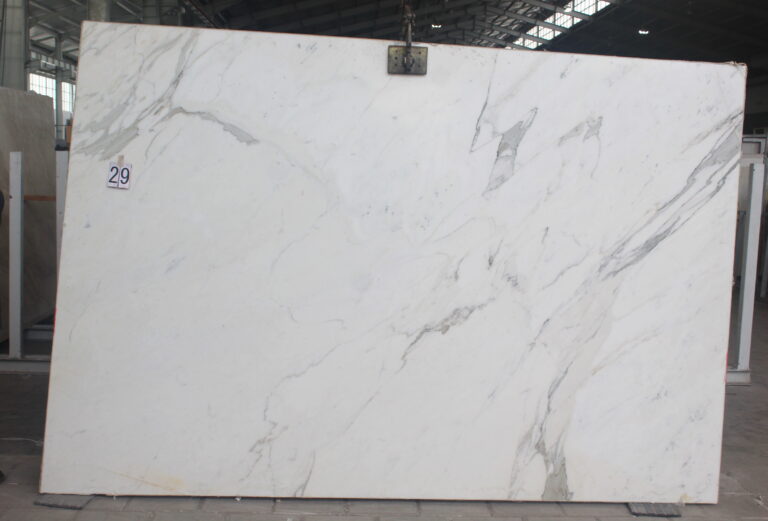
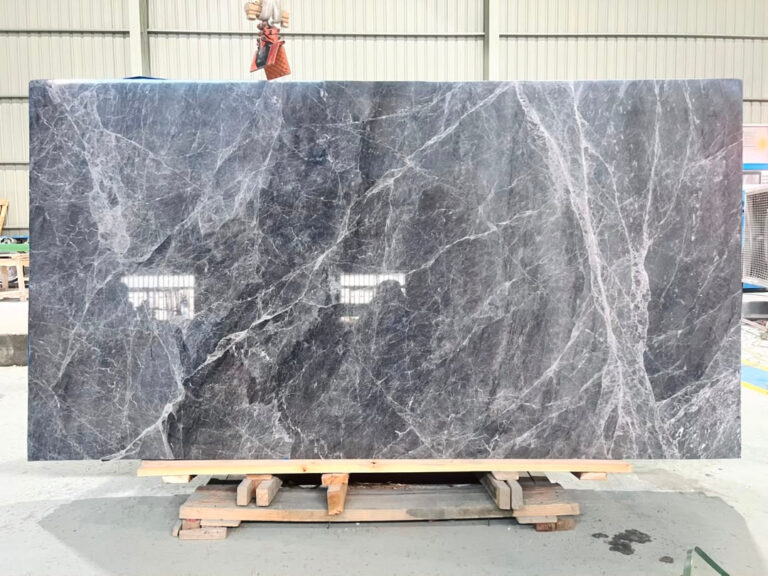
A single sample cannot define a natural material. Ask the supplier for a set of range samples showing the lightest, darkest and most typical appearance of the stone, and its veining at its busiest and quietest. Once approved, they are signed, dated and kept by both parties, and every delivery is judged against them.
When is a mock-up worth the cost?
Whenever the stone does something structural or visible at scale: a façade, a lobby floor, a feature wall with continuous veining. A mock-up tests what samples cannot — the fixing system, joint widths and colours, sealant, how the finish reads in the real light, and how installers handle the stone. Say who builds it, how it is approved, and whether it may remain in the works.
Should the architect select the slabs personally?
For veined marble, onyx and any stone where pattern is the point, yes. Specify that the designer attends slab selection, approves individual slabs or blocks, and approves a layout showing where each cut piece comes from. For large volumes, approve blocks rather than slabs and require each area to draw from one block. Slab numbers should follow the stone into the shop drawings, so any piece on site can be traced to its slab.
What about sealing, fixing, spare stock and sequencing?
These are the clauses most often left to the contractor, and the ones that most often go wrong:
- Sealing. Whether the stone needs it (its absorption will say), the type of sealer, who applies it and at what stage.
- Fixing method. Adhesive, mortar or mechanical anchors, with the fixing designed around the stone’s tested strength. Outdoors in the tropics the stakes rise; our guide to stone for Indonesia’s climate explains why.
- Overage and spare stock. A waste allowance, plus spare material from the same blocks, labelled and handed to the client for future repairs.
- Sequencing. Numbered pieces, shop drawings keyed to slab numbers, deliveries in installation order, and protection of finished surfaces until handover.
How to specify natural stone: a clause-by-clause template
| Clause | What to specify | Why it matters |
|---|---|---|
| Identity | Trade name, petrographic type, origin | Trade names alone are ambiguous |
| Appearance | Colour and veining by reference to signed range samples | Defines acceptable variation |
| Finish | Named finish tied to an approved sample | Finishes vary between suppliers |
| Thickness | By application, confirmed by the engineer | Governs strength, weight and fixing |
| Format and tolerances | Sizes, edges, tolerance class, lippage limit | Controls fit on site |
| Test data | Flexural strength, absorption, density, abrasion, slip on the specified finish | Proves suitability and feeds the fixing design |
| Mock-up | Location, scope, approval, retention | Tests what samples cannot |
| Slab selection | Designer attends; slabs or blocks and layouts approved | Controls pattern and consistency |
| Sealing | Need, product type, stage, applicator | Protects porous stone |
| Fixing | Adhesive, mortar or mechanical; engineered design | Safety and durability |
| Overage and spares | Waste allowance; spare stock from the same blocks | Repairs that match |
| Sequencing | Piece numbering, shop drawings, delivery order, protection | Keeps the approved layout intact |
How do you choose stone for a major interior project?
The questions people now put to search engines and AI assistants are longer and more anxious than they used to be: how do you select the right natural stone for a multi-million-dollar interior? The honest answer to how to specify natural stone at that scale is the checklist above, started earlier than feels necessary. A natural stone collection of hundreds of stones is a starting point, not a shortlist. Bring the stone supplier in at design stage rather than tender stage, since the blocks available shape the design as much as the reverse, and secure them before the drawings are frozen.
For the renovation of ION Orchard in Singapore, every 8mm laminated Stella Cream panel was pre-cut and vein-matched in Surabaya and arrived as a finished element needing no adjustment on site. Results like that are decided long before installation: in selection, in layout, and in the order of the pieces.
Frequently asked questions
What is the difference between a trade name and a petrographic name?
A trade name is the commercial name a stone is sold under, and it can vary between suppliers or cover stones from different quarries. A petrographic name describes what the rock actually is — marble, limestone, granite, quartzite — based on its mineral composition. A sound specification uses both, so the stone is identified commercially and geologically.
What test data should a natural stone specification include?
At minimum, flexural strength, water absorption and density for every application; abrasion resistance for floors and stairs; and slip resistance, tested on the specified finish, for wet and exterior areas. Reports should come from an independent laboratory, relate to the stone actually being supplied, and be recent enough to reflect the blocks now being quarried.
How many range samples should be approved?
Enough to show the stone’s full natural variation: a set covering its lightest, darkest and most typical appearance, plus its quietest and busiest veining. The number matters less than the coverage. Each approved sample should be signed, dated and kept by both parties, so every delivery can be checked against a shared, physical reference.
Who should select the slabs on a stone project?
For patterned stones such as veined marble and onyx, the architect or designer should attend selection in person, approve slabs or blocks, and approve a layout showing where each piece is cut. For plainer stones or very large volumes, approving blocks and range samples may be enough, provided every area draws from a single block.
Stone rewards the architect who describes it precisely; a careful specification is how the slab chosen in the yard becomes the surface standing in the finished room.