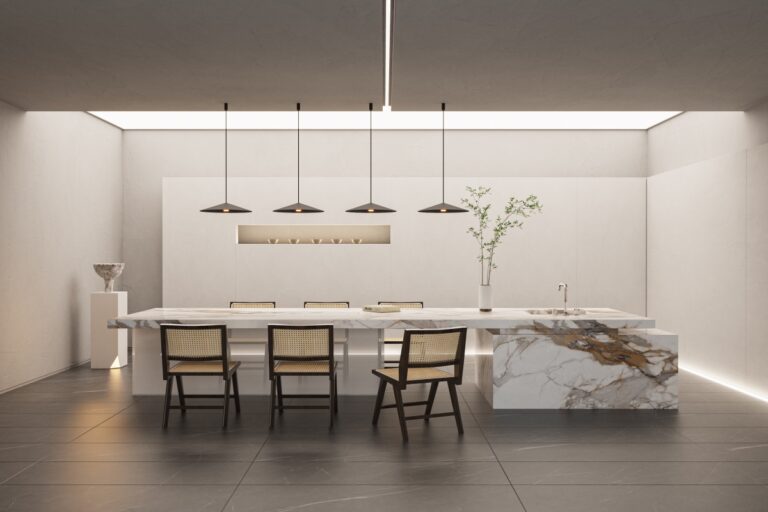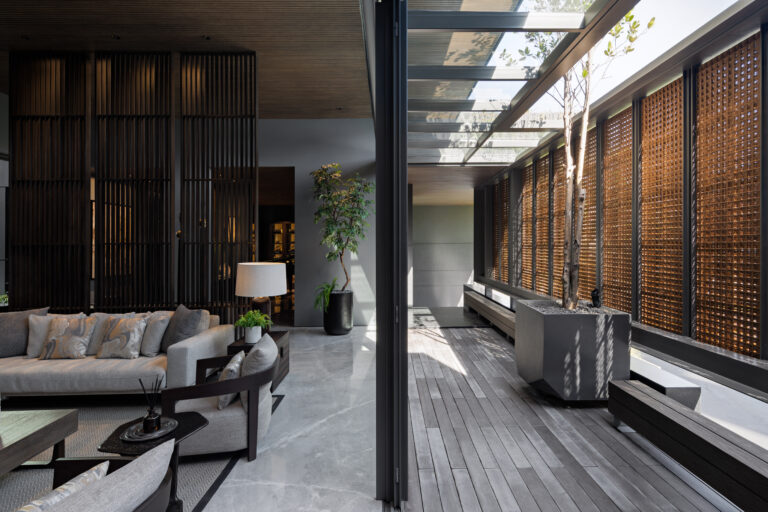
Fluted marble is natural stone with parallel, rounded grooves cut into its face, the same motif carved into Greek columns. Today it wraps kitchen island fronts, feature walls, vanities, columns, furniture and railings. Cut from solid stone rather than assembled from strips, every ridge carries the veining, so light and shadow move across the stone itself.
The motif is old. What is new is where designers want it: not only on columns at the entrance of a public building, but at hip height in a kitchen, on the front of a bath vanity, along the base of a dining table. That shift changes how the stone should be chosen, cut and cared for.
What is fluted marble?
A flute is a concave channel. Run a series of them side by side, separated by narrow ridges, and a flat surface becomes a field of light and shade. Stand in front of a fluted panel and the shadows sit in the channels; walk past it and they slide across, so the wall seems to move with you.
In marble the effect is doubled by the veining. A grey vein crossing a fluted face dips into each channel and rises over each ridge, so a single line of colour reads as a ripple. On a plain painted panel, fluting is pattern. On stone, it is pattern laid over pattern.
Is fluting the same as reeding?
No, although the two words are often swapped. Fluting is concave: the grooves are cut into the surface.
Reeding is the reverse, a row of convex, half-round ridges that stand out from it, like a bundle of reeds. Fluting tends to look crisper and more architectural, because each channel holds a dark line of shadow. Reeding looks softer and catches light on its crowns.
Both can be cut in stone. When a drawing says “fluted”, it is worth asking the designer which one they mean before a slab is touched, since the two are machined differently and cannot be converted afterwards.
Where did fluting come from?
From the column. Greek builders cut vertical flutes into the shafts of Doric and Ionic columns, and the device travelled through Roman, Renaissance and Art Deco architecture. Its job was partly optical: vertical shadow lines make a column look taller and more slender than a smooth shaft of the same width.
That is still the reason it works in an interior. Vertical flutes lift a low island or a short wall. Horizontal flutes do the opposite, stretching a long, low piece such as a console or a bench.
Why are designers returning to fluted stone?
Interiors magazines have charted the fluted kitchen island for several seasons. Living Etc has reported designers specifying fluted detailing more than ever, and Ideal Home has featured curved, fluted islands among 2026’s directions.
Homes & Gardens has also asked whether fluted cabinetry is now everywhere, with some designers suggesting it be used as an accent rather than across a whole room.
Both views point the same way. Fluting routed into a painted cabinet door can date quickly. Fluting cut into a natural stone tends to age like the stone does, because the pattern is part of the material rather than applied to it.
Where does fluted marble work best?
- Kitchen island fronts and waterfall ends. The most requested use. The flat top stays smooth for work; the front and sides take the texture where knees and hands rarely touch.
- Feature walls and reception desks. A fluted wall behind a reception counter or a bed gives a room depth without adding colour.
- Bath vanities and basin plinths. A fluted plinth under a stone basin is a quiet way to show a stone’s veining in the round.
- Columns and pillars. The original use, still effective when a structural column needs dressing.
- Furniture. Table bases, side tables, benches and lamp bodies, where fluting turns a solid block into an object.
- Railings and balustrades. A fluted stone balustrade gives a staircase or mezzanine the weight of architecture.
For more on the waterfall form itself, our guide to marble waterfall islands covers the mitred edge and the vein-wrap.
Which marbles suit fluting best?
The quieter the stone, the more the fluting shows; the louder the stone, the more the fluting recedes into it. That is the first decision.
A pale marble with soft, even veining lets the flutes do the talking: the shadow lines become the pattern. A strongly veined stone, such as a violet or a heavily marked breccia, reads differently. The flutes cut through the veins and turn them into a rippling, almost woven surface. Both are beautiful; they are not the same room.
Three practical points matter more than colour:
- Soundness. Fluting removes stone from the face and leaves thinner ridges. Stones with open fissures or heavy resin repairs need checking slab by slab before they are fluted.
- Thickness. Each channel takes depth out of the slab, so there must be enough stone behind the deepest point of the groove. Thicker stock, or a laminated backing, gives a deep flute more body.
- Finish. Honed fluting shows the shadow lines crisply and hides fingerprints. Polished fluting adds a bright highlight on every ridge. Our guide to honed, polished and leather finishes explains how each finish treats the veining.
How do flute width and depth change the look?
Width sets the scale; depth sets the drama. Narrow, shallow flutes read as texture from across a room, almost like corduroy. Wide, deep channels read as architecture, and the stone between them looks heavier.
| Profile | How it reads | Suits | Points to check |
|---|---|---|---|
| Narrow, shallow flutes | Fine texture, close to a pattern | Furniture, vanities, small panels | Fine ridges need a sound, even-grained stone |
| Wide, shallow flutes | Calm, contemporary rhythm | Island fronts, bedroom walls | Easiest to keep clean |
| Wide, deep flutes | Strong shadow, architectural | Columns, reception walls, railings | Needs more stone behind the groove |
| Reeding (convex ridges) | Soft, light-catching | Curved furniture, bar fronts | Crowns take wear first on touched surfaces |
| Fluting on a curve | Sculptural, three-dimensional | Round islands, columns | Every flute must line up across joints |
Design magazines in 2026 have noted a move towards wider flutes on islands, which give a more modern silhouette than fine grooves. In stone, wider channels also have a practical benefit: they are easier to reach with a cloth.
How is fluted marble made?
Fluting is cut, not added. The panel starts as a full slab, chosen and laid out so that the veining runs the way the design wants. The profile of each flute is drawn first: its width, depth, the radius at the bottom of the channel, and the width of the ridge between channels.
The channels are then cut one by one, each pass following the same line so that every flute matches its neighbour.
Then comes the slow part: finishing the inside of each groove to the same Honed or Polished face as the rest of the stone. A flute that is polished on its ridges but rough in its channels looks cheap in raking light, and raking light is exactly what a fluted surface is designed to catch.
Where a piece is made of several panels, the flutes must line up across every joint, and the veining should flow from one panel to the next.
That is why a careful workshop dry-fits fluted pieces and checks the joints before anything is crated. Bookmatching, which mirrors two consecutive slabs so the veining opens like a book, works especially well with vertical fluting.
Our factory-made fluted railing
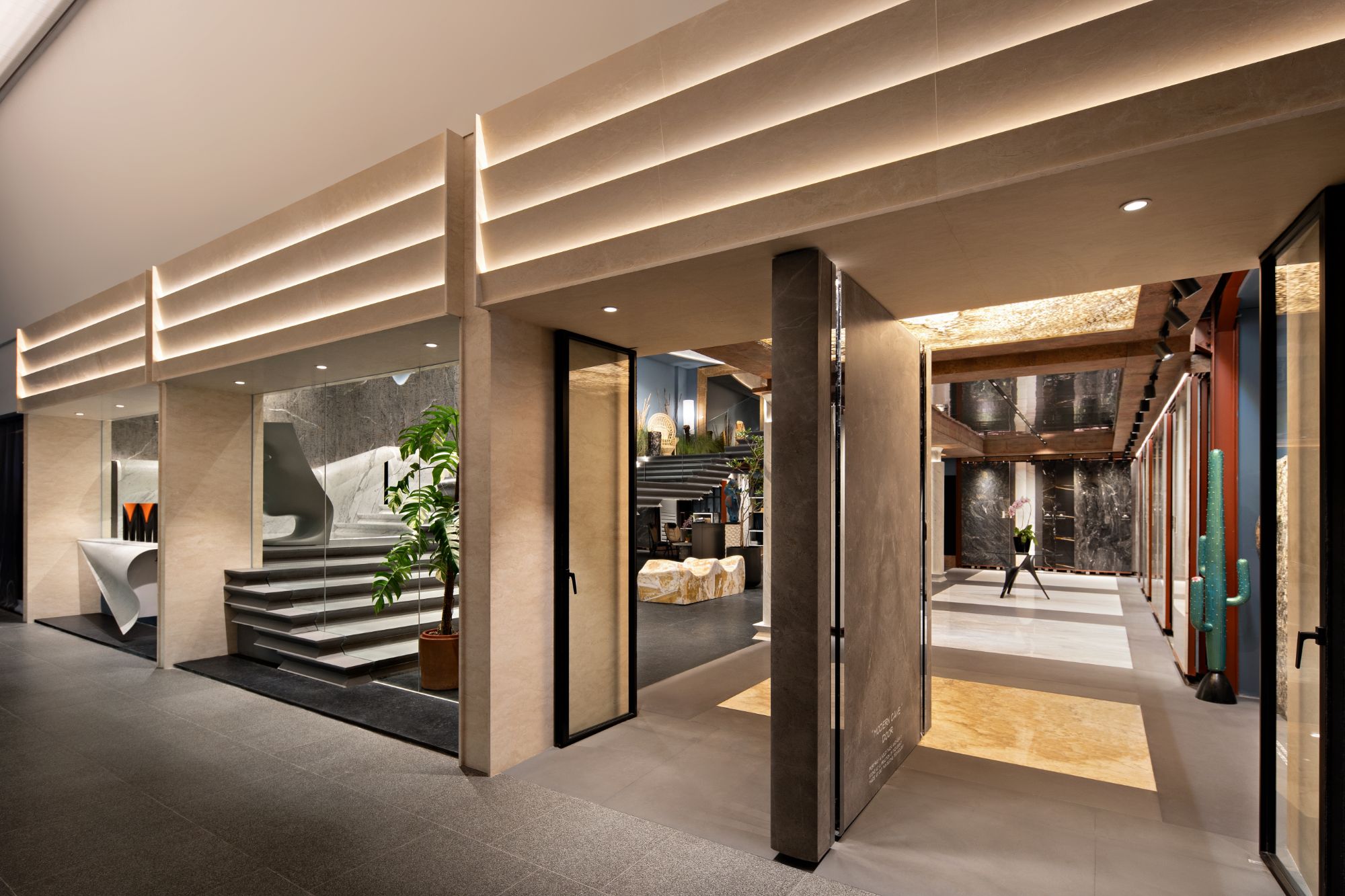
In our Alam Sutera showroom in Jakarta, part of the mezzanine railing is fluted and edged natural stone, made in our own factory in Surabaya.
That is the point of making it in-house. MM Galleri has cut and finished stone in Surabaya since 1992, and our pieces are cut, finished and prefabricated in our own workshops before they reach site. Millions of years in the making. Finished in our own workshops. You can see the railing on a visit to MM Galleri Jakarta, Alam Sutera.
How do you care for fluted marble?
Fluted stone is cared for like any marble, with one addition: dust and splashes collect in the channels.
- Dust with a soft, dry brush that reaches into each groove, then wipe with a damp microfibre cloth.
- Use a pH-neutral stone cleaner. Vinegar, citrus and many bathroom cleaners etch marble.
- On an island front, wipe splashes promptly, since drips run down into the channels.
- Keep the stone sealed as recommended for the stone and finish.
Our marble care guide covers the full routine.
Frequently asked questions
Is fluted marble a passing trend?
Fluting itself has been in architecture for more than two thousand years, so the motif is not new. What may fade is its use everywhere at once. Used where it has a reason, such as an island front, a column or a railing, fluting cut into natural stone tends to age with the stone rather than date with the fashion.
Is fluted marble hard to clean?
A little harder than a flat panel, because dust sits in the channels. A soft brush once a week and a damp microfibre cloth keep it clean. Wider, shallower flutes are the easiest to maintain. Honed fluting also hides fingerprints better than polished fluting on surfaces people touch.
Can any marble be fluted?
Most sound marbles can, but each slab should be checked first. Fluting leaves thinner ridges, so stones with open fissures or heavy repairs need care. The deeper the flute, the more stone is needed behind it. Strongly veined stones and quiet stones both work; they simply give very different results.
What is the difference between fluted and reeded stone?
Fluted stone has concave grooves cut into the surface, which hold lines of shadow. Reeded stone has convex, rounded ridges standing out from the surface, which catch light on their tops. Fluting looks crisper and more architectural; reeding looks softer. Confirm which one a drawing means before cutting, because one cannot be turned into the other.
Fluting asks a stone to do one simple thing, again and again, with perfect consistency; when it does, a still wall begins to move with the light.