
The honed vs polished finish question is really a question about light and touch: Polished gives a slab its mirror, its old-world shine, and its most visible fingerprints. Honed trades that shine for a soft, contemporary matte that hides wear. Leather sits between the two — textured enough to disguise etching, smooth enough to feel considered underhand.
Most people arrive at MM Galleri already fixed on a stone — a Statuario for a kitchen island, an Onyx Africa for a bathroom wall — and only discover afterward that the slab still has one more decision waiting inside it. Finish is that decision.
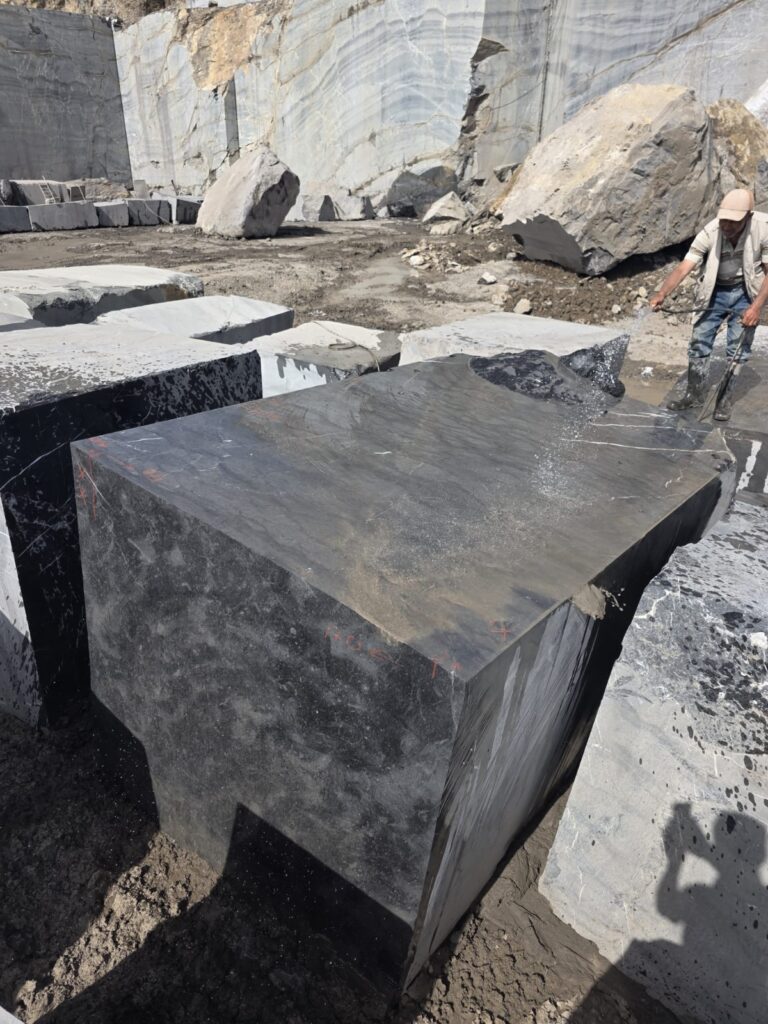
It is applied after the block is cut, after the veining has already declared itself, and it changes almost everything about how the stone will be lived with: how it catches a lamp at night, how forgiving it is of a dropped glass of wine, how loudly or quietly it sits in a room. Two identical slabs of the same marble, cut from the same block, can read as two entirely different materials once one is Polished and the other Honed — the honed vs polished finish difference in miniature.
What does each finish actually do to a slab?
Polished — high-gloss brilliance
Polishing is a mechanical process, the surface ground and buffed until it reflects like still water. It is the finish most people picture when they picture marble: a countertop that mirrors the kitchen pendant above it, a floor that seems to hold a second, upside-down room within it. Polished surfaces make veining read at its most dramatic — the gloss adds depth to the pattern, so a stone like Arabescato Violet or Onyx Linea looks lit from within even under ordinary daylight. The trade-off is honesty. A polished surface has nothing to hide behind, so fingerprints, water spots, and any acid etching from citrus or wine show immediately against the sheen.
Honed — soft matte
Honed finishing stops the process a step earlier, before the surface reaches full gloss, leaving a flat, velvety matte that reads as quieter and more contemporary. This is the finish behind the broader shift happening across residential design right now — a slow turn away from high-gloss surfaces toward ones that reward touch as much as sight, matte stone included. Honed surfaces still show the stone’s veining clearly, though with less theatrical depth than Polished; the pattern reads as drawn rather than lit. Because there is no mirror sheen to disrupt, honed marble and granite hide fingerprints, light scratching, and everyday etching far better — a genuine advantage in a working kitchen.
Leather — organic, smooth-yet-textured
Leather finishing goes a step further than Honed, adding a fine, tactile texture to the surface through hand or brush finishing rather than grinding it flat. Run a palm across it and the difference from Honed is immediate — subtly undulating, almost skin-like, closer to the feel of aged hide than of stone.
Leather is the most forgiving finish of the three on both fronts that matter most in daily use: its texture scatters light so effectively that fingerprints barely register, and its irregular surface disguises acid etching better than either Polished or Honed, since there is no flat plane for a dulled spot to stand out against. Veining softens slightly under Leather, gaining a warmth that some designers prefer to the crispness of Polished.
Satin — a fourth option worth knowing
Satin sits at a middle point in that spectrum, offering a subtle, velvety sheen rather than a flat matte or a full mirror. It is a useful middle path for anyone who wants the quiet of Honed with a whisper more light response — walls and vertical surfaces in particular benefit from Satin’s gentler shine, which avoids both the glare of Polished and the flatness that Honed can bring to a large surface.
Why is honed finish trending in 2026?
Design has been moving away from high-gloss surfaces for several seasons now, and the shift shows up clearly in finish requests: matte and tactile textures — Honed, Leather, Satin — are being specified in projects where Polished would once have been automatic. Part of this is visual, a preference for rooms that feel calm rather than mirrored. Part of it is practical — matte surfaces simply live better under the daily friction of a real household. The result is not that Polished has fallen out of favor so much as that it has become one option among several rather than the default.
How does finish change the way veining is seen?
Veining and finish are not separate — they read together. Polished intensifies contrast and depth, making dramatic veining like that in Onyx Africa or Arabescato Violet feel closest to lit glass. Honed flattens that contrast slightly, which suits stones with subtler, more linear movement — Onyx Linea’s soft luminous veining, for example, holds its own without needing gloss to carry it. Leather softens veining further still, blending pattern into texture rather than letting it sit on top of a mirror surface. As a rule: the bolder the veining, the more Polished rewards it; the quieter or more linear the veining, the more Honed and Leather let it breathe.
Where does each finish show wear first?
Wear is where the decision matters most in daily life:
- Polished shows wear earliest and most visibly — fingerprints on a kitchen island, water spots around a sink, dulled patches from acidic spills all stand out against the mirror sheen, particularly on marble and other calcite-based stones prone to etching.
- Honed hides the same wear considerably longer. Etching still happens chemically — the surface still dulls where acid touches it — but because the whole surface is already matte, a dulled spot has far less contrast to give it away.
- Leather hides wear best of the three. Its texture does the most work of any finish to scatter light and disguise both fingerprints and etching, making it a practical choice for an island that sees real cooking rather than only styling.
- Satin falls between Honed and Polished, showing fingerprints more readily than Honed but etching less visibly than full Polished.
What about MM Galleri’s other finish textures?
Polished, Honed, Satin, and Leather cover the everyday range, but they are four of ten finishes in MM Galleri’s full library — the rest built for more specific, more textured, and in some cases more sculptural applications. Anticato brings an aged-stone warmth suited to interiors built around a sense of history.
Flamed and Sandblast are largely exterior and flooring finishes — rugged, fire-born texture in the first case, a fine grainy surface that softens light and improves grip underfoot in the second, both useful anywhere slip resistance matters. Native strips the surface back to something closest to the stone’s raw essence, while Stripe and Flute introduce linear pattern and rhythm across a surface, Flute pushing further into sculptural territory than Stripe.
At the furthest, most sculptural end of that spectrum sits Sierra, MM Galleri’s textured wall-cladding finish born from a 2008 request by a client in Bali — a story, and a texture, substantial enough to deserve its own article rather than a paragraph here.
Honed vs Polished Finish Comparison Table (Plus Satin and Leather)
| Finish | Look & sheen | Feel & texture | Best use case | Maintenance note |
|---|---|---|---|---|
| Polished | High-gloss, mirror-like reflection; deepens veining contrast | Smooth, hard, glass-like underhand | Formal living areas, feature walls, floors and islands built for visual drama | Shows fingerprints, water spots, and acid etching fastest; needs the most regular wiping |
| Honed | Soft matte; veining reads flatter, quieter | Smooth but non-reflective, slightly softer to the touch | Kitchen countertops, bathroom floors, contemporary interiors favoring a calm surface | Hides fingerprints and light etching well; occasional sealing recommended on porous stones |
| Satin | Subtle, velvety sheen between matte and gloss | Smooth with a faint softness, less flat than Honed | Vertical surfaces, feature walls, spaces wanting gentle light response without glare | Moderate — better than Polished at hiding marks, less forgiving than full matte |
| Leather | Organic, low sheen; veining softens into texture | Smooth-yet-textured, subtly undulating, tactile | High-use kitchen islands, bathroom vanities, surfaces meant to be touched often | Best of the four at disguising fingerprints and etching; texture also masks minor scratches |
| Anticato, Flamed, Sandblast, Native, Stripe, Flute | Ranging from aged and rugged to raw and linear | Ranging from coarse and grainy to sculpted and dimensional | Exteriors, flooring, feature walls, and bespoke sculptural surfaces | Specific to application — best discussed slab by slab with the MM Galleri team |
MM Galleri’s most sculptural finish, Sierra, takes the matte-and-texture logic described above to its furthest extreme. For an independent perspective on choosing between finishes, the Natural Stone Institute’s guide to selecting a stone finish is a useful second reference.
Frequently asked questions
Honed vs Polished Finish: Which Is Better for Kitchen Countertops?
For most working kitchens, Honed is the more forgiving choice — it hides fingerprints, water spots, and light etching far better than Polished, which shows every mark against its mirror sheen. Polished still suits kitchens built more for entertaining than daily cooking, where the visual drama of a reflective surface matters more than resistance to everyday wear.
Does a leather finish hide fingerprints and etching better than polished?
Yes. Leather’s texture scatters light rather than reflecting it, so fingerprints and water marks barely register, and acid etching has no flat, glossy plane to dull visibly against. Of the three main finishes, Leather is consistently the most forgiving for high-touch surfaces like kitchen islands and bathroom vanities used daily.
Can honed and leather finishes be applied to granite as well as marble?
Yes, though the effect differs. Granite is harder and less prone to acid etching than marble, so Honed and Leather finishes on granite are chosen mainly for their look and feel rather than for extra protection. On marble and other calcite-based stones, the same finishes offer a genuine practical advantage against everyday etching.
Does Honed Marble Show Scratches More Than Polished?
Generally less. A polished surface’s reflectivity makes even fine scratches visible as breaks in the mirror sheen, while a honed surface’s uniform matte already lacks that sheen, so fine scratching blends in rather than standing out. Deeper scratches remain visible on any finish and depend more on the stone’s hardness than on its surface treatment.
Does finish change the color of the stone itself?
This is another dimension of the choice: it does not change a stone’s mineral color, but it changes how that color is perceived. Polished intensifies saturation and depth through reflected light; Honed and Leather mute that same color slightly, reading softer and more muted. The stone underneath — an Onyx Africa, a Luna Breccia — remains the same; only the way light leaves its surface differs.
Can a finish be changed later, after installation?
Within limits. Polished surfaces can often be honed down through re-grinding, and lightly worn Honed surfaces can sometimes be re-polished, though the process is disruptive and best planned before installation rather than after. Leather’s texture is the hardest of the three to reproduce or reverse on-site, which is worth weighing carefully at the selection stage.
The honed vs polished finish decision — and where Leather fits into it — is, in the end, a choice about how a surface should live in a room — reflective or quiet, dramatic or forgiving, seen from across the room or felt underhand every day. The veining stays the same stone either way; the finish decides how loudly it speaks, and how gracefully it wears.