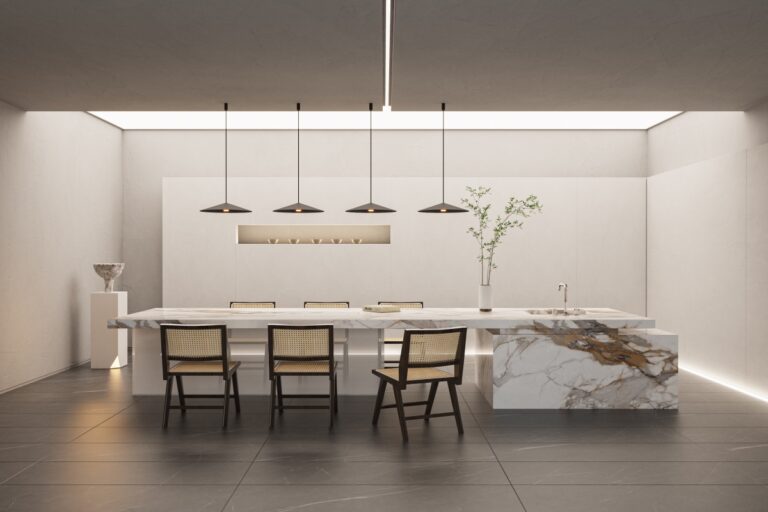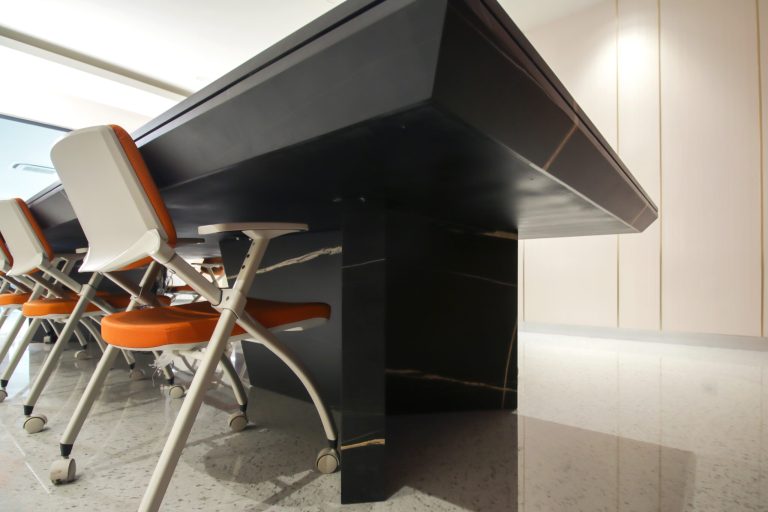

Full body engineered stone carries its colour and veining through the whole thickness of the slab, not only on the face. Cut an edge, drill a hole or chip a corner, and the same material continues. A printed surface works differently: the design sits on top of a body of another colour, and the edge reveals it.
From the front, at a distance, many engineered surfaces now look alike. Large slabs with marble-like veining are made in several ways, and photographs flatten the difference. The place to look is the edge, because the edge is where a slab shows what it is made of all the way through.
What does “full body” mean?
Full body, sometimes called through-body, describes a surface whose colour, pattern and character run from the top face through to the back. If you sliced the slab at any depth, you would see the same material.
Natural stone is full body by nature. A vein in a marble block was formed in the rock over geological time, so it runs through the stone in three dimensions. That is why a marble edge can be rounded, mitred or carved and still look like marble. Engineered surfaces only behave this way when they are made to.
What is the alternative to a full body surface?
Makers and the trade use a few terms, and they are not always used consistently. Roughly, there are three families.
- Surface-decorated. The pattern is applied to the top face, often with digital printing, over a body of a plain base colour. The face can look remarkably like stone. The edge shows the base body.
- Colour body. The body is tinted to roughly match the surface, so a chip or edge is less obvious, but the veining does not continue into it.
- Full body. Colour and veining continue through the thickness, so an edge or cut-out reads as part of the same material.
Italian slab maker Fratelli Pellizzari, for example, describes body-pigmented slabs as giving greater colour continuity at chips, cuts and exposed edges, compared with colour carried in a surface glaze. The principle holds across the category.
Why does the edge show the difference?
Because the edge is the one place where the inside becomes the outside. On a flat panel fixed to a wall with its edges hidden, a printed surface can be convincing. The moment a design asks the material to show its thickness, the construction becomes visible.
These are the details that expose it:
- Rounded and decorative edges. A bullnose or a layered triple bullnose cuts down into the body. On a printed slab, the curve reveals the base colour beneath the pattern.
- Mitred corners and waterfall ends. Two pieces meet at an angle. On a full body surface, veining can be arranged to turn the corner. On a printed one, a thin line of body colour shows at the joint.
- Sink and hob cut-outs. An undermount sink exposes the cut edge of the opening all the way round.
- Drilled holes and notches. Tap holes, socket cut-outs and notches around columns all expose the body.
- Chips. A chip on a printed surface shows a different colour. On a full body surface, it shows more of the same, which also makes it far less noticeable.
Is full body the same as solid colour?
No. A plain, single-colour surface is easy to make full body: the whole mix is one colour. The harder thing is veining. Making a vein travel from the face, down through the thickness and out at the edge is what separates a full body veined surface from one that only looks veined from the front.
Lapitec, which is part of our engineered collection, describes itself on its own site as a “full-bodied” sintered stone. In 2019 it presented what it called the world’s first sintered stone slabs with veining running all the way through. Those are the maker’s own words, and they show how recently through-body veining became a selling point in the category.
How can you check whether a surface is full body?
Do not rely on the name of the product or a photograph of its face. Check the material itself:
- Ask for an edge sample. A cut, unpolished edge shows the body honestly. A polished bullnose sample shows how it will look on your top.
- Look at the back of a slab. On some products the back is a plain base colour; on a full body surface it shows the same material.
- Read the maker’s technical sheet. Look for the words “full body” or “through-body”, and check whether they apply to colour only or to veining too.
- Ask about your exact detail. If the drawings show a mitred waterfall, a bullnose or an undermount sink, ask to see that detail in that product.
Which edges suit which surface?
| Detail | Surface-decorated | Colour body | Full body |
|---|---|---|---|
| Flat panel, edges hidden | Works well | Works well | Works well |
| Square or eased edge | Body visible at the edge | Close match at the edge | Same material at the edge |
| Bullnose or triple bullnose | Base colour exposed on the curve | Pattern lost on the curve | Pattern continues on the curve |
| Mitred waterfall | Visible line at the joint | Thin colour line possible | Veining can turn the corner |
| Undermount sink | Cut edge shows base body | Tinted body shows | Same material inside the opening |
| A chipped corner | Contrasting colour shows | Less visible | Same material shows |
Where does SINISO fit?
SINISO is sintered stone: minerals pressed and fired into one dense body. Its maker, New Jincheng Group, is one of the Top 10 international ceramic companies by its own account. The maker is NSF certified.
In Indonesia, SINISO is selected and distributed exclusively by MM Galleri. It was unveiled on 19 September 2026 at Indonesia Design Week in Jakarta, and our Indonesia Design Week article tells that story.
SINISO shows why the word “body” needs reading closely. Its 63 colours sit in four collections: Full Body, Speckled Body, Coloured Body and Onyx. Every slab measures 1600 × 3200 × 12 mm.
In the Full Body colours, colour and veining run from the face to the back. Cut, mitre or round the edge, and the stone carries on. The Luxury colours among them, whose body the factory calls Translucent Full Body, are also semi-translucent at a full 12 mm.
Speckled Body is tinted and lightly speckled to follow the surface tone, so edges and chips stay discreet. Coloured Body puts super-white and beige bodies under marble, limestone and travertino designs, and Onyx holds four onyx designs. More on the material is on our SINISO page, and our team can arrange to show you the slabs.
Why does a full body matter more as trends move?
Edges are back in fashion. Designers and design magazines are calling decorative profiles such as ogee and triple bullnose, along with waterfall ends, a 2026 kitchen direction, and every one of them puts the thickness of a material on display. A surface that only works with a hidden, square edge is limited to the quietest designs.
A full body gives the designer back the freedom that natural stone always had.
At MM Galleri, we cut and finish decorative edges, including triple bullnose, in our own workshops in Surabaya, where we have worked stone since 1992. The material decides which of those edges will look right. Our Lapitec collection and our natural stones are good places to start that comparison.
Frequently asked questions
What is full body engineered stone?
It is a manufactured surface whose colour and veining continue through the whole thickness of the slab, rather than being printed or applied only on the face. An edge, a cut-out or a chip shows the same material as the top. The term is also written “through-body”. Always check whether a maker means colour only, or veining as well.
Can a printed surface have a bullnose edge?
It can be cut, but the curve passes through the printed layer into the body beneath, so the base colour shows around the edge. That is why printed surfaces are usually given square, eased or mitred edges. For a bullnose or triple bullnose, a full body material or natural stone gives a far more convincing result.
Is natural stone full body?
Yes, by nature. Veins in marble, granite or quartzite were formed in the rock and run through it in three dimensions, so any edge, cut-out or carving reveals more of the same stone. The pattern changes as you cut deeper, exactly as it would in the block, which is part of the character of natural stone.
Is SINISO full body?
Some colours are. SINISO comes in four collections: Full Body, Speckled Body, Coloured Body and Onyx. In the Full Body colours, colour and veining run from the face to the back, so the edge carries on. Speckled Body follows the surface tone; Coloured Body sits on a super-white or beige base. Ask our team which body suits a particular edge.
An honest surface has nothing to hide at its edge; the best ones invite you to look closer there.