How to clean marble surfaces the right way
To clean marble, use only a pH-neutral stone cleaner or warm water with a soft cloth — never vinegar, lemon, or bleach, whose acids etch marble’s calcite structure on contact. Wipe spills immediately, reseal the surface roughly once a year, and accept that marble will soften and shift in tone over decades. That shift is not damage. It is the stone keeping a record of the life lived on it.
Why marble needs a different hand than engineered stone
Marble is calcium carbonate, laid down over millions of years and polished into something that looks, at a glance, indestructible. It isn’t. The same mineral structure that gives marble its luminous veining also makes it porous and reactive — a stone that breathes, absorbs, and responds to what touches it, rather than resisting everything the way an engineered surface does.
Compare it honestly to the sintered and quartz surfaces MM Galleri also carries. Dekton and Lapitec are dense, largely non-porous, engineered to shrug off acid, heat, and stains without a second thought. Silestone, a quartz blended with resin, behaves the same way. Marble was never built to compete on those terms, and asking it to is the wrong comparison. It competes on depth of veining, on the way light sits inside it, on a beauty that engineered stone can echo but not originate. That beauty comes with a maintenance vocabulary of its own — and once you learn how to clean marble the right way, care becomes routine rather than anxiety.
What does daily marble cleaning actually look like?
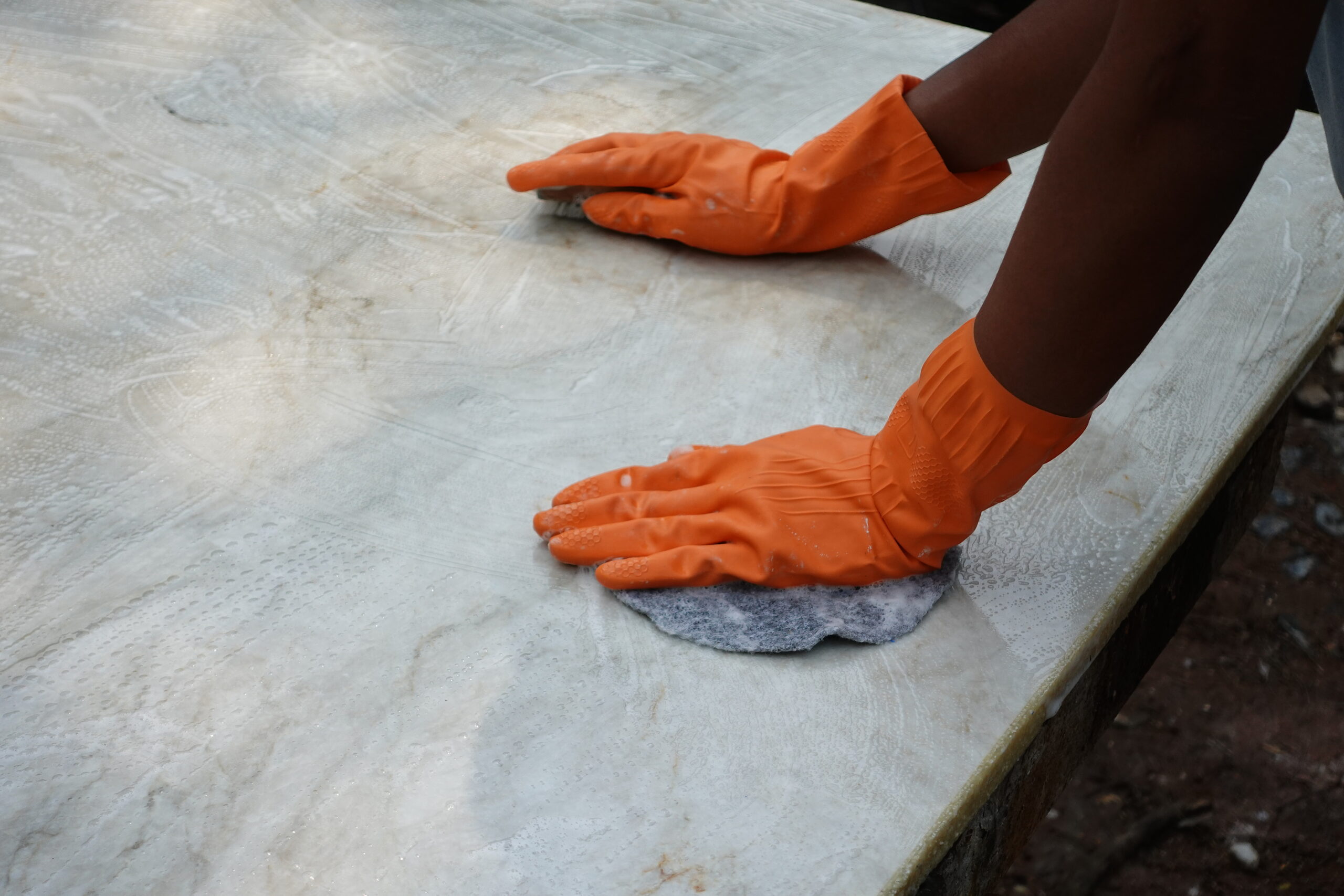
To clean marble daily, keep it simple: a soft, non-abrasive cloth, warm water, and — when needed — a stone-specific, pH-neutral cleaner formulated for marble and other calcite stones. Nothing more.
- Wipe up dust and light residue with a dry or barely damp microfiber cloth.
- For anything heavier, use a pH-neutral stone cleaner diluted as directed, applied with a soft cloth, then rinsed with clean water and dried.
- Dry the surface after cleaning. Standing water, over time, can dull the polish and work its way toward the seal.
That is the entire daily ritual for how to clean marble well. The discipline is less about product and more about avoiding the wrong ones.
Why do vinegar, lemon, and bleach ruin marble?
Vinegar, lemon juice, and other acidic household cleaners etch marble because they dissolve the calcium carbonate at the surface — a chemical reaction, not a stain, and one that shows up as a dull, cloudy patch even after the liquid is wiped away. Bleach and ammonia-based cleaners strip the sealant and can discolor the stone. None of these belong anywhere near marble if your goal is to clean marble safely, no matter how often a household tip suggests otherwise.
This is worth repeating because it is the single most common way marble gets damaged: not by heavy use, but by a splash of lemon in the kitchen sink, a glass of wine left overnight, or a well-meaning citrus-based cleaner reached for out of habit. Etching is a chemical event on a mineral surface — once it happens, it can sometimes be buffed out by a professional, but it cannot be wiped away.
How to Clean Marble After a Spill
Blot the spill immediately — don’t wipe, which can spread an acidic liquid across a wider area — then rinse the spot with water and a pH-neutral cleaner and dry it thoroughly. Wine, coffee, citrus juice, tomato sauce, and oil are the highest-risk spills in a home: acidic, pigmented, or fat-based, and each capable of leaving a mark if left to sit for more than a few minutes.
Speed matters more than force here. A spill blotted within a minute rarely leaves a trace. The same spill left through a dinner party can etch or stain permanently.
How often should marble be resealed, and how do you know it’s time?
Reseal marble roughly once a year in normal residential use, more often in high-traffic kitchens or outdoor applications exposed to weather. The honest way to know is a simple water test: place a few drops of water on the surface and watch. If the water beads and sits, the seal is holding. If it darkens the stone within five to ten minutes, absorbing into it, the seal has worn through and it’s time to reapply.
Sealing doesn’t make marble immune to acid — nothing does — but it slows absorption, buys precious minutes when a spill happens, and reduces staining from oils and pigments. Think of it as a maintained boundary, not a permanent shield.
What should never touch a marble surface?
- Acidic cleaners — vinegar, lemon, citrus-based sprays, most “natural” DIY cleaning mixes.
- Bleach and ammonia — strip sealant, discolor stone.
- Abrasive pads, steel wool, or scouring powders — scratch the polish permanently.
- Standing acidic liquids — wine, juice, coffee, tomato-based sauces left to sit.
- Generic all-purpose or bathroom cleaners — most are formulated for grout and tile, not calcite stone, and are acidic enough to etch marble over repeated use.
How to Clean Marble: Care at a Glance
| Task | Frequency | What to use | What to avoid |
|---|---|---|---|
| Wipe down | Daily | Soft cloth, warm water | Paper towels on polished finishes (can leave micro-scratches over time) |
| Deep clean | Weekly, or as needed | pH-neutral stone cleaner | Vinegar, lemon, ammonia, bleach |
| Spill response | Immediately | Blot, rinse, dry | Wiping acidic spills across the surface |
| Seal test | Every 6–12 months | Water-drop test | Assuming the seal lasts indefinitely |
| Resealing | ~Once a year (more in kitchens, outdoor settings) | Stone sealant suited to marble | Skipping it after the first application |
| Scratches or etching | As they appear | Professional honing/polishing | DIY abrasive pads or acid-based “fixes” |
Living with marble’s patina
Marble was never meant to stay exactly as it left the quarry. Every marble surface that has lived through decades of dinners, mornings, and passing hands carries a faint record of that use — a slight softening of the polish underfoot, a shade shift where a hand has rested for years. Well cared for, this is not deterioration. It is patina: the same quality that lets a 400-year-old Italian church floor still read as beautiful rather than tired.
MM Galleri has spent 33 years — since 1992, from a single workshop in Surabaya — sourcing and fabricating marble from more than 400 varieties, and the pattern holds across all of them: the slabs people love most in ten or twenty years are rarely the ones kept pristine under glass. They are the ones cared for consistently and used without fear. Knowing how to clean marble correctly — daily habits, prompt attention to spills, a seal renewed on schedule — is what lets that patina arrive as character rather than damage. Marble rewards patience with something engineered stone cannot offer — a surface that ages the way the people living around it age, gathering history instead of just wearing out.
For a broader look at how finish choice affects long-term upkeep, see MM Galleri’s guide to Honed vs Polished vs Leather Finish. And for a second opinion beyond this guide, the Natural Stone Institute publishes its own marble countertop care guidelines, which echo the same core rule: gentle, pH-neutral, and consistent beats occasional and aggressive.
Frequently asked questions
Can I use dish soap to clean marble? Occasionally and diluted, but it isn’t ideal for daily use — many dish soaps are formulated to cut grease and can leave a film that dulls marble’s polish over time. A dedicated pH-neutral stone cleaner is built specifically for calcite stones like marble and won’t leave that residue behind.
Is it hard to clean marble in a kitchen? Marble asks for consistent, not constant, attention — a quick wipe, a fast response to spills, and an annual reseal. Many households manage this easily once it becomes routine. If you prefer near-zero maintenance, an engineered surface like Silestone or Dekton is the more forgiving choice for heavy kitchen use.
How do I remove an existing stain or etch mark from marble? Light etching can sometimes be buffed out with a marble-specific polishing powder, but deeper etching or set-in stains generally need a professional honing and polishing service to restore the original finish safely without damaging the stone further.
Does sealing marble make it stain-proof? No sealant makes marble stain-proof or acid-proof. Sealing slows how quickly liquids absorb into the stone, which buys time to wipe up a spill before it marks the surface — it reduces risk, but the daily habits still matter more than the seal itself.
Can I use marble outdoors? Yes, with the right finish and more frequent sealing — outdoor marble is exposed to rain, UV, and temperature swings that accelerate wear, so a honed or textured finish and a tighter resealing schedule are usually recommended over a high-polish finish in exterior settings.
What’s the difference in care between marble and granite? Granite is denser and less porous than marble, so it tolerates acidic spills and daily wear with more patience, though it still benefits from periodic sealing and a pH-neutral cleaner. Marble is the more reactive of the two and needs the more disciplined routine described above.
Marble has never needed to be perfect to be worth having. It needs to be understood — treated gently, cleaned correctly, and allowed to carry its years honestly. Get the daily habits right, and the stone does the rest, the way it always has.