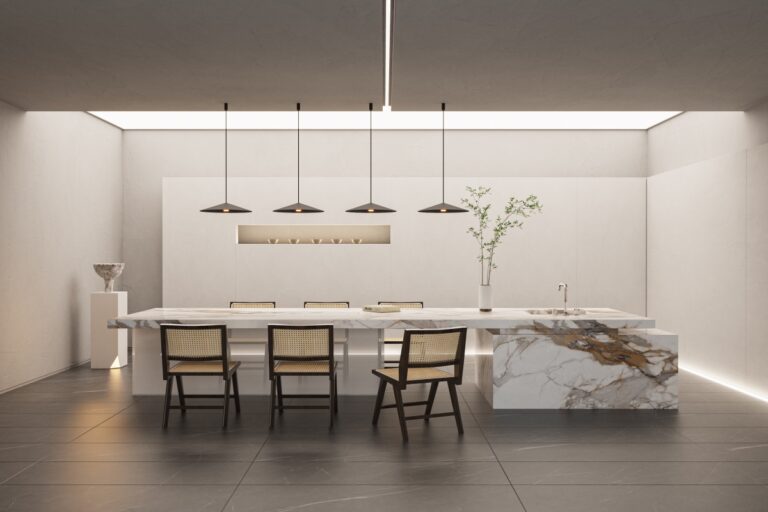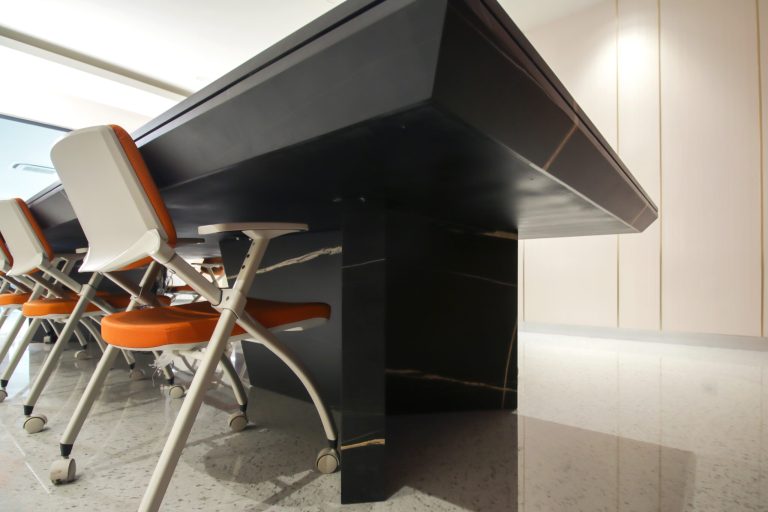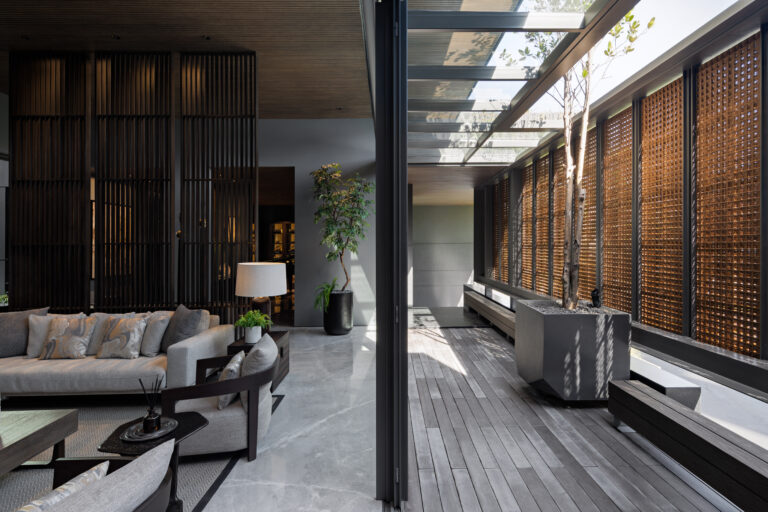
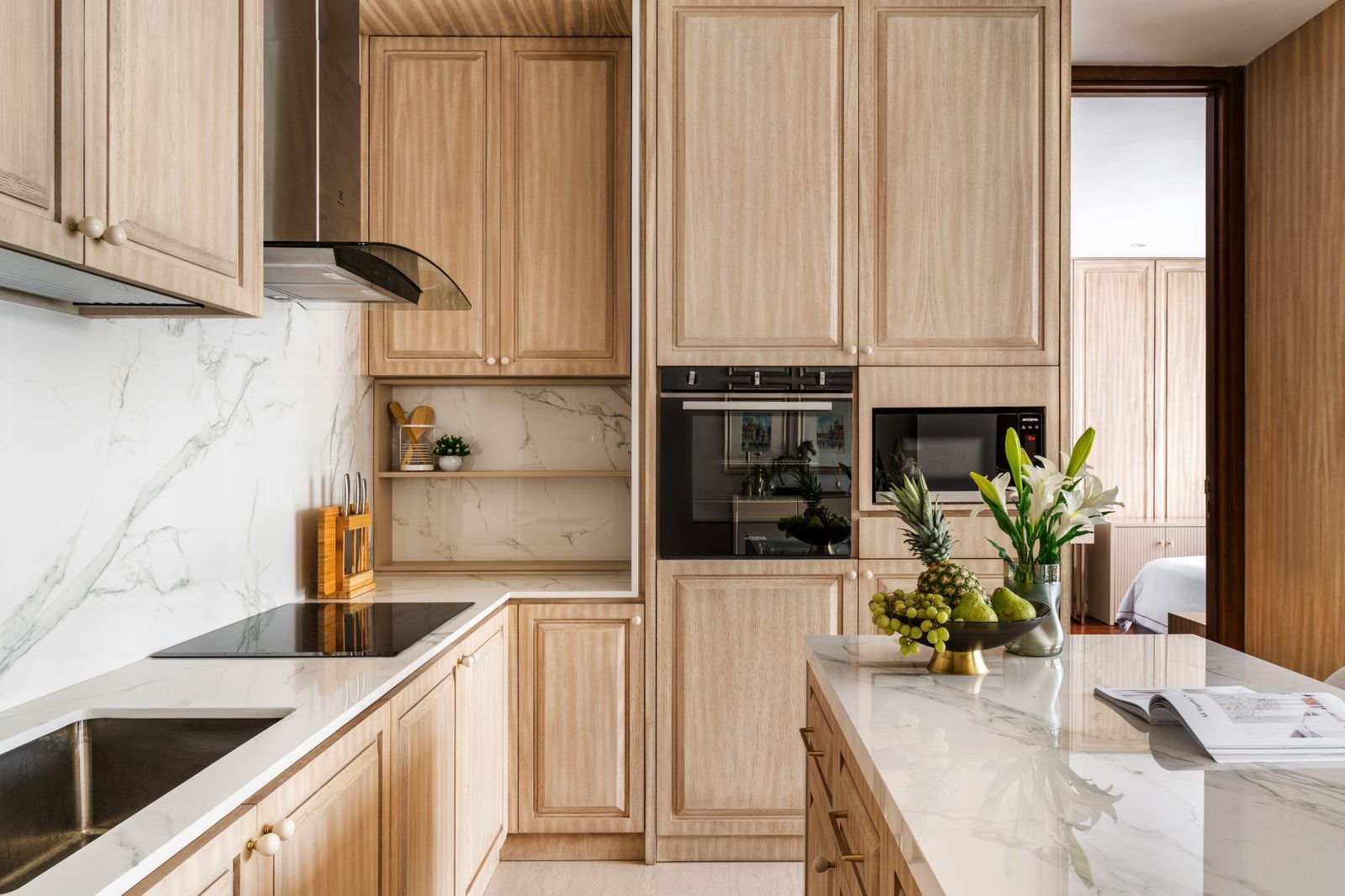
A pencil edge is a near-square stone edge whose top corner is rounded to a small, even radius, a little fuller than an eased edge, which only softens the corner. Both are the minimalist answer to this year’s decorative edges: they let the stone and its thickness speak, and both chip far less than a true square edge.
While design magazines fill their pages with ogee and triple bullnose profiles, the quieter half of the edge trend is happening in contemporary kitchens.
There, the question is not which ornament to add, but how little to take away from the corner. A few millimetres of radius decide how a worktop feels under the hand, how thick it looks, and how well it survives daily life.
For the full family of edge profiles, see our guide to countertop edge profiles. This article looks closely at the two simplest.
What is a pencil edge?
The pencil profile keeps the face of the stone flat and vertical, but rounds the top corner to a small, deliberate radius, roughly the curve of a pencil’s side. The radius most often quoted by fabricators is around 3 to 6 millimetres. Some versions soften the bottom corner slightly as well; others leave it square.
The result reads as a clean, square-ish edge with a visible soft line along the top where the light rolls over the curve. It feels comfortable to the hand without looking rounded.
What is an eased edge?
An eased edge is a square edge with the sharp arris taken off. The radius is very small, commonly around 3 millimetres or less, just enough that the corner no longer feels sharp and is less likely to chip. From a step away, it looks square.
The eased edge is the default on most contemporary worktops, and with good reason. It is crisp, architectural, easy to clean and almost invisible as a design choice, which is exactly what a minimal kitchen wants.
Why do the two get confused?
Because they sit next to each other on a scale, and the names are not standardised. One workshop’s eased edge is another workshop’s pencil. Some fabricators use the terms interchangeably; others draw a firm line between them.
The safe way to order either is not by name but by measurement. Write the radius on the drawing, in millimetres, for the top corner and the bottom corner.
Better still, ask to see or touch a sample of that exact radius on the stone you are buying, because the same radius looks softer on a honed surface than on a polished one.
How does the radius change the look of the stone?
This is the part most people do not expect. The radius on the top corner changes how thick the worktop appears.
A very small radius keeps almost the full height of the edge face flat and visible, so the slab reads at its true thickness.
A larger radius curves away part of that face, and the eye reads the remaining flat band as the thickness. The stone can look slightly thinner, which is why some writers note that the pencil profile can make a top look a little slimmer than an eased one.
On a thick top, or on a mitred edge built up to look like a solid block, that hardly matters. On a standard slab with no build-up, a designer who wants the top to look substantial will often choose the smaller radius of an eased edge.
Which is better for a marble kitchen?
For marble, we lean towards the pencil profile. Marble is largely calcite, a soft mineral, and the corner of a worktop takes the knocks: a pan handle, a chair back, a child’s toy. A slightly fuller radius spreads an impact over a curve instead of a line, so it is less likely to take a chip out of the stone.
For harder stones such as granite and quartzite, the eased edge is usually enough. Their hardness protects the corner, so the crisper look costs little in durability.
Lifestyle writers make a similar point for households with young children, where the softer pencil profile is the kinder choice. The difference in feel is small, but it is real.
Why is the minimal edge part of the 2026 edge trend?
Design publications this year describe two movements at once. One adds ornament to the edge: ogee, fluted, triple bullnose. The other strips the edge back so that a thick slab or a dramatic vein carries the design. The pencil and eased edges belong to the second.
They pair naturally with the other things designers are asking for: honed surfaces, warm stones, strongly veined slabs and monolithic islands. A violet-veined marble with a quiet edge lets the veining be the event; the same stone with an ogee can feel like two statements competing.
How do pencil and eased edges work on mitred and waterfall tops?
They are what make a mitred corner practical. A mitred edge, where a second piece of stone is joined at 45 degrees to make the top look like a solid block, leaves a sharp outer corner. Left razor-sharp, it chips. Eased or given a small pencil radius, it survives, and the block still looks solid.
The same applies at the top corner of a marble waterfall island, where the stone folds down to the floor. A fine radius protects the fold without breaking the line of the veining as it turns.
Should the edge be polished or honed?
The edge should normally match the top. On a polished stone, the radius catches a single fine line of light along the full length of the worktop, which is part of the pencil profile’s charm. On a honed stone, that line becomes a soft shadow, and the edge reads as calmer still.
A polished edge on a honed top shows fingerprints and etching that the top hides, and looks like a separate band. Our honed vs polished finish guide covers the trade-off in full.
How are these edges made in our workshops?
We cut and finish edges in our own workshops in Surabaya, from the simplest eased edge to decorative profiles such as the triple bullnose, together with the tops they belong to.
A simple edge is not a lesser edge: the radius has to stay even along the full length of the worktop, through every joint and around every corner, or the line of light along it breaks.
Bring the radius you want, in millimetres, to one of our showrooms, or a photograph of an edge you like, and talk it through with the slab in front of you.
Square, eased and pencil compared
| Square | Eased | Pencil | |
|---|---|---|---|
| Top-corner radius | None | Very small, often about 3 mm or less | Small, often about 3 to 6 mm |
| Look | Sharp, architectural | Crisp, reads as square | Clean with a soft top line |
| Apparent thickness | Full | Full | Slightly slimmer |
| Chip resistance on marble | Low | Good | Very good |
| Feel under the hand | Sharp | Softened | Comfortable |
| Best stones | Hard stones only | Granite, quartzite, engineered, marble | Marble and other softer stones |
| Best rooms | Rarely advisable on worktops | Minimal kitchens, bathrooms | Family kitchens, contemporary rooms |
Frequently asked questions
Is a pencil edge the same as an eased edge?
Not quite, although some fabricators use the names loosely. An eased edge only takes the sharpness off the corner with a very small radius. A pencil profile rounds the top corner a little more, to a small but visible curve. Specify the radius in millimetres to avoid confusion.
Which edge chips less on marble?
The pencil profile, slightly. Its fuller radius spreads a knock over a curve rather than a thin line, so less stone breaks away. Both are far more forgiving than a true square edge, which is the profile most likely to chip on a soft stone such as marble.
Does a pencil edge make a countertop look thinner?
It can, a little. The rounded top corner takes away part of the flat face that the eye reads as thickness. On a thick or mitred top the difference is hardly noticeable. Where the top should look as substantial as possible, a smaller eased radius keeps more of the face visible.
Are pencil and eased edges going out of style?
Unlikely. They are the quietest edges available, which is why they rarely date. Decorative profiles move with fashion; a simple, well-made radius suits almost any room, contemporary or classical, and lets the stone itself carry the design.
Can an eased edge be re-cut to a pencil profile later?
Often, yes. Because a pencil profile removes a little more stone than an eased one, a skilled fabricator can usually re-profile an installed eased edge on site. Going the other way, from a rounded edge back to a crisper one, is much harder.
The smallest edges are the hardest to hide behind; a few millimetres of curve, made true along every metre, is where a quiet kitchen is won.