Waterjet marble inlay is stone marquetry cut by machine. A jet of water at very high pressure, carrying a fine abrasive, follows a digital drawing through each stone, so pieces of different colours lock together with hairline joints. They are assembled face down, bonded to a backing, and ground and finished as one surface.
Setting coloured stone into stone is one of the oldest decorative arts in architecture. Roman builders cut shaped pieces of marble into the floors and walls they called opus sectile; the workshops of sixteenth-century Florence refined the idea into pietre dure, pictures made of hard stones cut by hand and fitted piece by piece. The waterjet has not changed what an inlay is. It has changed how precisely, and how large, one can be made.
What is a waterjet, and why does it suit marble?
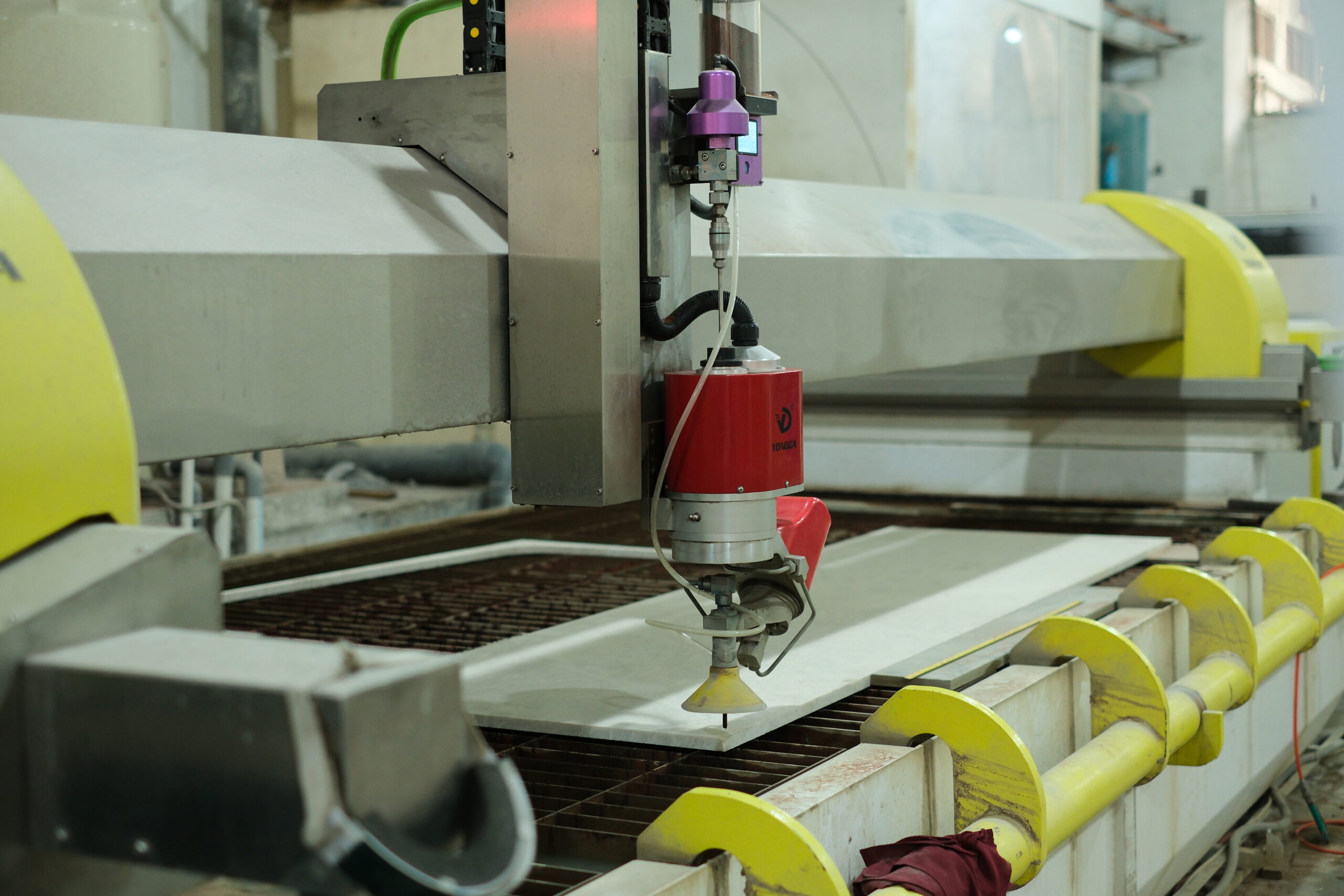
A waterjet cutter pressurises water to thousands of bar and forces it through an orifice finer than a pencil lead. For stone, a fine garnet abrasive is drawn into the stream, and the mixture erodes a narrow line through the slab as the cutting head follows a programmed path.
Three things make it suited to inlay. It cuts cold, so there is no heat to crack or discolour the stone. It follows any curve, including tight internal corners a saw blade cannot reach. And its kerf — the width of material it removes — is narrow and consistent, which is what allows two neighbouring pieces to meet with almost no gap.
How does a drawing become cut stone?
Every inlay begins as a drawing. The design is redrawn digitally as a set of closed shapes, one for each piece, and each colour is assigned a stone. The cutting path is then offset by half the kerf, so the piece cut from one stone and the opening cut in another share exactly the same line.
The shapes are then placed on the slabs with the veining in mind. A petal cut across the grain of a stone reads differently from one cut along it, and good inlay work lays each piece on the slab the way a tailor lays a pattern on cloth, so the movement of the stone follows the movement of the design.
How do the pieces lock together?
In a well-cut inlay every line is cut twice: once as the outside of one piece, once as the opening that receives it. Because both follow the same compensated path, the pieces fit like a jigsaw and the joint shrinks to a fine line, closed with resin tinted to disappear between the colours on either side. The interlocking shapes help the assembly hold together, so each piece is supported by its neighbours as well as by the bond beneath it.
How is an inlay assembled and backed?
Assembly is done face down on a flat table, so the show faces lie in a single plane regardless of small differences in thickness. The joints are bonded, and the whole composition is backed — with a stone or composite backing slab, a reinforcing mesh, or a lightweight panel for walls — so it can be lifted and installed in one piece or in a few sections. Large medallions are often divided along lines within the design, so the joints between sections hide inside the pattern.
Why should the stones in a floor inlay wear at the same rate?
This is the rule most often broken, and the one that shows years later. Stones differ in hardness and resistance to abrasion. Put a hard granite beside a soft marble, or a dense marble beside a softer limestone or onyx, and foot traffic slowly wears the softer stone into shallow dishes while its neighbour stands proud. The polish dulls unevenly too, until the design reads as worn and unworn patches rather than as colours.
For floors, choose stones of similar hardness, ideally comparing their abrasion test data. Keep the softest and most fragile stones, onyx above all, for walls, tabletops and places nobody walks. A floor inlay is a composition in wear as much as in colour.
How is an assembled inlay finished?
Once set, an inlay is finished as a single surface. On floors this is often done after installation: the medallion and the surrounding floor are ground together so no lip remains between them, then honed or polished to the specified finish. Grinding across the assembly is also what brings the resin joints and every stone into one plane, which is why a good inlay feels as smooth as a single slab underfoot. Sealing follows, and the inlay is cared for like any marble floor; our marble care guide covers the routine.
Waterjet marble inlay from drawing to floor
| Stage | What happens | What to check |
|---|---|---|
| Design | Drawing converted into closed digital shapes, one per piece | Slivers and sharp points too small to survive cutting |
| Stone selection | A stone assigned to each colour | Similar hardness for floors; one block per colour |
| Nesting | Shapes placed on the slabs with the veining | Vein direction in each piece |
| Cutting | Abrasive waterjet cuts pieces and openings on a kerf-compensated path | Fit between pieces; clean edges |
| Assembly | Pieces bonded face down on a flat table | Joint width; resin colour |
| Backing | Backing slab, mesh or lightweight panel added | Weight; where sections divide |
| Installation | Set into the surrounding floor or wall | Level with adjacent stone |
| Finishing | Ground, honed or polished and sealed as one surface | No lippage; even finish across every stone |
Where is waterjet marble inlay used?
Floor medallions in entrance halls and places of worship, borders that run around a room, emblems set into lobby floors, wall panels, tabletops and stair landings. At 7 Hartley Grove in Singapore, a residence of creams, golds and sweeping curves, MM Galleri laid waterjet inlay floors.
In Surabaya, the floor of Maha Vihara & Pusdiklat Buddha Maitreya carries a large circular lotus medallion, worked in cream, rose, rust and dark-green marbles and held within a running border band. It is the kind of piece where everything above meets: a drawing divided into pieces, stones chosen for colour and for how they will wear together, and a finish that lets the whole read as one.
Inlay sits close, too, to MM Galleri’s Silhouette work, begun in 2020: stone artworks, stone paintings of whatever a designer imagines.
Frequently asked questions
How precise is waterjet marble inlay?
Precise enough that neighbouring pieces meet in a joint little wider than a line of resin. Accuracy depends on the machine, the stone’s thickness and the care taken over kerf compensation and nesting. Very thin points and slivers set the limit: below a certain size, a piece of marble becomes too fragile to cut, handle and set reliably.
Can onyx be used in a floor inlay?
It is better kept off the floor. Onyx is softer and more fragile than most marbles, so underfoot it wears, scratches and dulls faster than the stones around it, and a design that mixes them ages unevenly. Onyx inlays are at their best on walls, tabletops and backlit panels, where its translucency can be seen and nobody walks.
Is waterjet inlay the same as pietra dura?
They share an idea but not a method. Pietra dura, or pietre dure, is the Florentine tradition of pictures made from hard stones cut and fitted by hand. Waterjet inlay uses a digitally guided abrasive water jet to cut the pieces. The machine brings repeatability and scale; hand work still matters in selection, fitting and finishing.
How do you clean a marble inlay floor?
As you would any marble floor: dust or dry-mop regularly, wash with a pH-neutral stone cleaner, and wipe up acidic spills quickly, since vinegar, citrus and many bathroom cleaners etch marble. Keep the floor sealed as recommended for the stones used. Periodic professional honing can restore an even finish if traffic wears paths into it.
An inlay asks many stones to behave as one; cut precisely and chosen well, they go on doing so long after the floor around them has been walked smooth.