
Breccia Violetta is a natural marble of pale, angular fragments held in seams of violet, lilac and plum. The name is generally given to a violet breccia from Tuscany, a relative of the historic Breccia Medicea. It is at its best where the pattern can be seen whole: a wall, a vanity, a fireplace.
There is a particular moment when a slab of this stone is first stood up in good light. From a distance it reads as one soft colour, between lavender and old rose. Walk closer and the surface breaks apart into hundreds of pieces, each one outlined in a darker line. That double reading is the whole character of the stone.
What is a breccia?
Breccia is an Italian word that geology adopted for a rock made of broken fragments. At some point in its history the original rock was shattered, by faulting, collapse or the movement of the earth. The angular pieces were then cemented together again by finer material that filled the gaps.
When such a rock is later buried and transformed by heat and pressure, it becomes a brecciated marble. The fragments, usually paler, keep their sharp outlines. The cement between them, which often holds more iron and other minerals, takes on the colour. In a violet breccia, that colour is purple.
Not every stone sold as a breccia is the same. Fragment size, the ratio of fragments to cement, and the intensity of colour all change from one quarry level to the next.
Where does Breccia Violetta come from?
Most sources place it in Tuscany, in the marble country of the Apuan Alps and the Versilia hills around Seravezza and Stazzema. The University of Oxford’s Corsi collection of decorative stones refers to “breccia violetta from Seravezza” when discussing a related specimen. Other suppliers attribute their stone to the Carrara area or to the Vagli valley.
That region has a long history with purple stone. In the sixteenth century Grand Duke Cosimo I de’ Medici held the monopoly on the Seravezza quarries, and the violet breccia from there still carries his family’s name: Breccia Medicea.
The honest answer is that the name is a trade name, not a protected origin. Ask any seller to name the quarry district of their particular blocks.
How is Breccia Violetta different from Calacatta Viola?
Both are Italian marbles marked in violet, and some traders blur the names. Some Calacatta Viola blocks break into pieces too, so look at the ground and the overall tone: Breccia Violetta’s fragments sit on a pale, often pinkish ground and the slab reads as one soft colour, while Calacatta Viola keeps a bright, cool white and higher contrast.
| Breccia Violetta | Calacatta Viola | |
|---|---|---|
| Pattern | Angular fragments held in seams | Flowing bands in some blocks, large white pieces in thin veins in others |
| Colour | Violet, lilac and plum on a pale, often pinkish ground | Plum, violet and grey on a bright white ground |
| Overall tone from a distance | Softer, more of a single colour | Higher contrast, more graphic |
| Feeling in a room | Warm, romantic, enveloping | Dramatic, bright and graphic |
Do not confuse either with Arabescato Violet, a Turkish marble whose white fragments sit in wine and plum seams. It looks like a breccia too, and costs less than the Italian stones. Treat these as tendencies, not rules: the slab matters more than the name, so ask where the block was quarried.
What does a slab look like up close?
The fragments range from the size of a fingernail to the size of a palm, sometimes larger. Their colour runs from cream and pearl to pale pink. Between them, the seams carry violet, plum and lilac, and in some slabs thin lines of grey or soft green cross the pattern.
Polished, the stone has depth. You seem to look into it rather than at it, and the fragments appear to float. Honed, the colour lifts and turns chalkier, closer to a dusty mauve.
Small natural voids and fine fissures are part of a breccia’s nature, since the stone was once loose rubble. Processors usually fill them with resin and often reinforce the back of the slab. Our article on resined marble explains why this is normal and what good resin work looks like.
Where does this violet breccia work best?
On surfaces that are seen whole and from a little distance, so the eye can take in both the overall tone and the fragments.
Feature walls and bathrooms. A full wall behind a bath or a bed lets the pattern spread out. In a powder room, the stone can wrap the room entirely.
Vanities and splashbacks. One slab running from the counter up the wall gives a strong, continuous composition.
Fireplaces. The warm violet suits firelight, and a surround is protected from heavy wear.
Furniture. A dining table or console in this stone becomes the piece a room is built around.
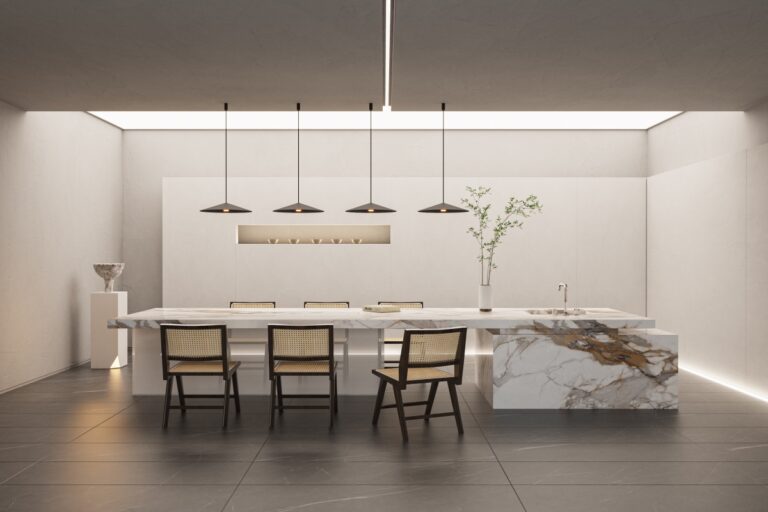
Kitchen worktops are possible with care, as with any calcite marble. Many designers prefer the stone on an island, where it is admired more than it is worked.
How does the breccia pattern affect cutting and joints?
This is where a breccia asks more of its fabricator than a calm white marble. A joint that cuts across a large fragment shows clearly, and a mismatched seam can make two slabs look like strangers.
Plan the layout with the slabs in view. Decide which way the fragments should travel, where the joints fall, and how pieces meet at an edge. Bookmatching, opening two consecutive slabs like the pages of a book, gives breccia a mirrored symmetry that reads as intentional.
We cut, finish and prefabricate pieces in our own workshops in Surabaya before installation, including bookmatched panels and decorative edges. Our guide to choosing marble slabs covers what to look for when you select them.
Does a violet breccia need special care?
It needs the care any marble needs, with one extra point. Like all calcite stone, it can be etched by acids such as lemon juice, wine and vinegar, so spills should be wiped promptly and a pH-neutral cleaner used.
The extra point is the resin in filled areas. Avoid harsh solvents and very hot pans directly on the surface. For a kitchen or bar, StainZero, our own factory-applied coating for natural stone, adds resistance to scratches, heat and strong acids.
Polished or honed is a matter of taste, but it affects care too: etching shows more on a high polish. Our guide to honed and polished finishes sets out the trade-offs.
FAQ
Is Breccia Violetta an Italian marble?
The name is generally given to a violet breccia from Tuscany, from the Apuan Alps and the Versilia area around Seravezza. It is a trade name rather than a protected origin, however, so ask the seller to name the quarry district of the blocks you are being shown.
Is Breccia Violetta the same as Breccia Medicea?
They are related and sometimes overlap. Breccia Medicea is the historic violet breccia of Seravezza, named after the Medici, who controlled the quarries in the sixteenth century. Breccia Viola and the violetta are used by traders for stones of similar character, with loose boundaries between them.
Can a violet breccia be used for a kitchen countertop?
Yes, with the care any marble needs. Acids can etch the surface, so wipe spills quickly and use a pH-neutral cleaner. Many designers place it on an island rather than the main working counter. A factory-applied protective coating such as StainZero adds resistance to scratches, heat and acids.
Why do violet breccia slabs vary so much?
Because a breccia is made of fragments, and the size, colour and density of those fragments change through the quarry. Two blocks with the same name can differ in tone from lilac to plum. Choose from the actual slabs, and take all the slabs for one project from the same block where possible.
Is it normal for a breccia slab to have resin in it?
Yes. A breccia formed from cemented fragments, so small voids and fissures are natural. Processors fill them with resin and often reinforce the back of the slab. Good resin work is close in colour to the stone and does not yellow over time; ask your supplier what resin they use.
Millions of years in the making. Finished in our own workshops.