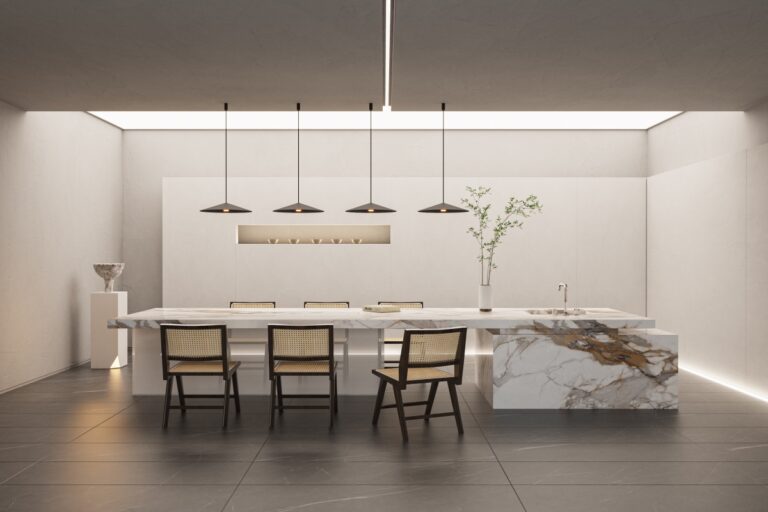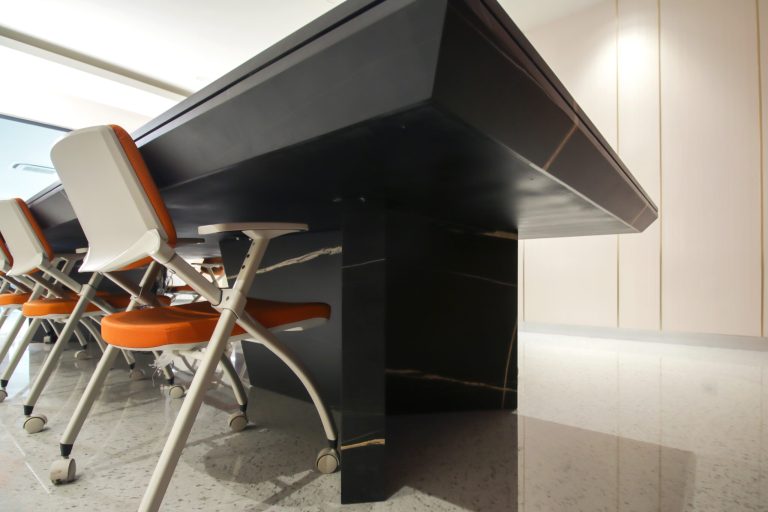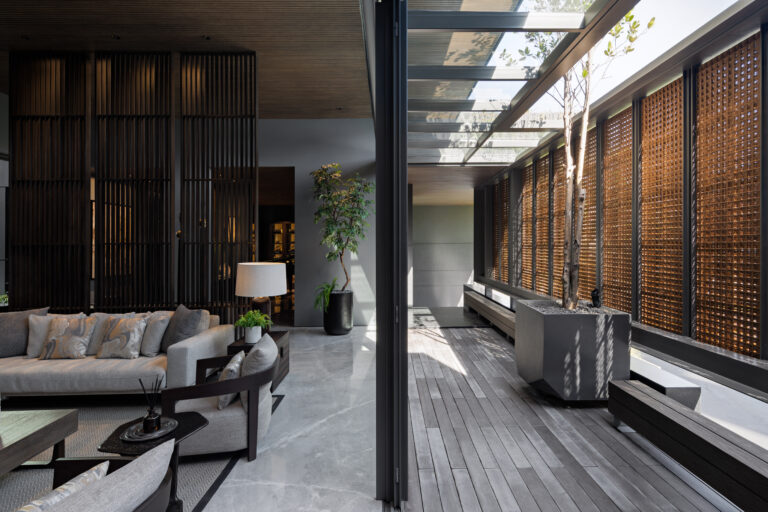

Lilac White marble is a natural white marble with soft lilac and grey veining, generally quarried in western Turkey. It is the quietest of the violet marbles: from across a room it reads as white with a cool, faintly purple movement. That restraint lets it cover whole walls, floors and bathrooms, where a bold violet breccia would overwhelm.
Most of the violet stones now in demand are loud by design. Calacatta Viola and the Tuscan breccias are chosen to be the one thing a guest remembers.
Lilac White does something different. It brings a little colour into a room without asking the room to be built around it, which is exactly why some designers reach for it when the brief says “purple, but not too much”.
What does Lilac White look like?
The ground is a bright, cool white, sometimes leaning towards a soft pale grey. Across it run veins in lilac, mauve and grey. Suppliers describe the movement as organic and unpredictable: some slabs carry fine, feathered lines, others a few bolder, darker strokes.
What sets the stone apart is the colour of those veins. In ordinary white marble the veining is grey or charcoal. Here it carries a violet cast, strongest where the veins are thickest and fading to grey where they thin out.
Light changes it more than you might expect. In cool daylight the lilac comes forward. Under warm evening lamps the veins drift towards grey-mauve and the stone reads almost as a classic white marble. See a sample in the room it is meant for.
Where is Lilac White quarried?
Most suppliers place it in western Turkey. Many name the Milas area, a long-established marble district in the southwest of the country; others refer to the Marmara region. You may also see it sold as Milas Lilac or simply as Lilac marble.
It should not be confused with Calacatta Lilac, a separate stone that one supplier describes as Iranian. Turkish stone, in general, comes in a wide range of white marbles with coloured veining, and Lilac White is one of the better-known violet examples.
As with every trade name, the label is not a guarantee of origin. Ask the seller where the blocks you are being shown were quarried.
How is Lilac White different from the other violet marbles?
The violet marbles form a scale, from quiet to dramatic. Lilac White sits at the quiet end. The table below places it among the others in our collection, as the trade generally uses the names.
| Stone | Intensity of colour | Pattern | Best suited to |
|---|---|---|---|
| Lilac White | Soft; reads as white from a distance | Feathered lilac and grey veins | Whole bathrooms, floors, full walls |
| Arabescato Violet (Turkey) | Strong, high contrast | White fragments packed in wine and plum seams | One vanity, one tabletop, one wall |
| Breccia Violetta | Moderate to strong, warm | Fragments in violet and plum seams | Feature walls, vanities, furniture |
| Calacatta Viola (Italy) | Strong | Violet and grey veining on bright white, flowing in some blocks and broken in others | Bookmatched walls, one island |
The practical consequence is scale. Because its colour is gentle, Lilac White can be used across many square metres without the room feeling busy. A bold breccia used the same way can become tiring.
Where does Lilac White work best?
On large, continuous surfaces, where its calm movement can carry a whole room.
Bathrooms. Floor, walls and vanity in the same stone give a serene, enclosed feeling. The lilac in the veins keeps it from feeling as clinical as an all-white room.
Floors. In living areas and entrance halls, a soft-veined marble shows less visual noise across a large floor than a dramatic one.
Feature walls. Behind a bed or a sofa, bookmatched panels give a gentle mirrored pattern. Our article on bookmatched marble walls explains how it is done.
Fireplaces, vanities and tabletops. Suppliers in Europe often show it on fireplace surrounds and furniture, where the veins can be seen up close.
It can also work in a kitchen, with the care any white marble needs.
Why choose a quiet violet over a bold one?
Because it is easier to live with for a long time. A bold breccia makes a statement on day one, and the statement does not change. A softer stone like Lilac White reveals itself more slowly. You notice the colour in the veins on a bright morning, and the room still feels calm in the evening.
It is also more forgiving in what it sits beside. Pale oak, walnut, nickel, brushed brass, sage green and warm grey all work with it. Strong colour, such as deep green tiles or a plum velvet, can be added later without the stone fighting it.
Our view: if a client loves violet stone but worries about tiring of it, Lilac White is usually the answer. Save the dramatic breccia for a powder room or a single piece of furniture.
Polished or honed?
Polish deepens the lilac in the veins and gives the white a luminous depth. It suits walls, vanities and furniture.
Honing softens everything. The white turns a little chalkier and the veins look greyer, which suits floors and kitchens because etching and fine scratches show less on a matt surface. Ask to see both finishes on a sample before deciding.
How do you keep a white marble looking white?
The same way you care for any marble, with a little extra attention because marks show more on a pale ground. Lilac White is calcite stone, so acids in lemon juice, wine, vinegar and some cleaners can etch it, leaving a dull patch. Coffee, oil and red wine can stain it if left to soak in.
Wipe spills quickly, use a pH-neutral cleaner, and reseal as advised. Our guide to cleaning and caring for marble covers daily care in detail.
For a kitchen or a busy family bathroom, StainZero, our own factory-applied coating for natural stone, adds resistance to scratches, heat and strong acids. It is applied in our workshops before the stone is delivered.
How should you choose Lilac White slabs?
See them in person, and see them together. The veining varies from slab to slab, from almost plain white to strongly marked. For a floor or a whole bathroom, choose slabs from the same block so the tone stays consistent.
The Lilac White stone page gives a first impression. The slabs themselves, in daylight, tell you far more. We cut, finish and prefabricate every piece in our own workshops in Surabaya before installation, including bookmatched panels and edges.
FAQ
Is Lilac White marble purple or white?
Mostly white. The ground is a bright, cool white, and the veins carry lilac, mauve and grey. From across a room it reads as a white marble with a soft violet movement; up close the colour in the veins becomes clear. Cool daylight brings the lilac forward, warm light makes it greyer.
Where does Lilac White marble come from?
Most suppliers place it in western Turkey, often naming the Milas area, while others mention the Marmara region. It is also sold as Milas Lilac or Lilac marble. Trade names do not guarantee origin, so ask the seller where the particular blocks were quarried.
Is Lilac White the same as Calacatta Lilac?
No. They are different stones that share a word. Lilac White is generally described as a Turkish marble with lilac and grey veining on white. Calacatta Lilac is a separate stone that suppliers describe as Iranian. Always compare the actual slabs rather than relying on the name.
Is Lilac White suitable for bathroom floors?
Yes. Its soft veining suits large areas, and a honed finish gives better grip and hides fine wear. Like any marble it needs sealing and a pH-neutral cleaner. For a whole bathroom, choose slabs from one block so the floor, walls and vanity match in tone.
Does Lilac White stain easily?
It is no more prone to staining than other white marbles, but marks show more on a pale ground. Wipe coffee, oil and wine quickly, avoid acidic cleaners, and reseal as advised. A factory-applied coating such as StainZero adds resistance for kitchens and busy bathrooms.
Millions of years in the making. Finished in our own workshops.