Onyx countertops are among the most luminous surfaces stone can offer: banded, translucent and able to glow when lit from behind. They are also soft, easily scratched and etched by acids, and often reinforced with resin or mesh. Onyx belongs on bar tops, vanities and backlit feature counters, not on a working kitchen counter.
Onyx is the stone people fall for across a room. Its bands of honey, ivory, green or white read less like pattern than like light held inside the slab, and when a lamp is placed behind it, it glows. That quality is exactly why it is worth being clear-eyed about where onyx countertops belong. Used in the right place, onyx is unforgettable. Used as a chopping surface, it will disappoint within a month.
What is onyx, and why does it behave differently from marble?
The onyx used in interiors is almost always a banded form of calcite, laid down layer by layer from mineral-rich water in caves and around springs. Those slow layers create its bands, and its large, clear crystals let light pass through. It is a different material from the gemstone onyx used in jewellery, which is a form of quartz. Our introduction to what onyx stone is covers its origins in more depth.
Because it is calcite, onyx sits in the same soft range as marble. The difference is that onyx is more brittle and more often laced with natural fissures, so it carries weight and impact less well. Where marble is a forgiving companion that ages into a patina, onyx is a more delicate one that asks to be placed with care.
Why are onyx slabs often resined or meshed?
Most onyx slabs are treated before they reach a showroom. Resin is drawn into the natural fissures and micro-cracks to bind the slab and give it a continuous surface for polishing, and many slabs are also backed with a fibreglass mesh bonded to the underside to hold them together during cutting, transport and installation. This is standard practice for fragile stone rather than a sign of a poor slab.
It does have consequences. A mesh backing can show as a faint grid when the slab is backlit, which is why backlit onyx is often given a clear backing or laminated to glass instead. And the resin that holds a slab together can soften or mark under heat, which is one more reason a hot pan and an onyx counter should never meet.
Do onyx countertops scratch and etch?
Yes, readily. Onyx is soft enough that ceramic bases, grit on the underside of a bottle or a dragged pan will scratch it. Like marble, it reacts with acids: lemon juice, wine, vinegar, many cocktails and a good number of bathroom cleaners leave dull etch marks where they touch the surface. On polished onyx, which is how most onyx is finished to show its depth, those marks are especially visible.
Onyx can also stain, particularly along fissures and resin lines, if oils or coloured liquids are left to sit. None of this makes onyx a bad stone. It makes it a stone for surfaces that are admired and used lightly, rather than worked hard.
Where do onyx countertops work best?
The best places for onyx share two things: they are used gently, and they benefit from light.
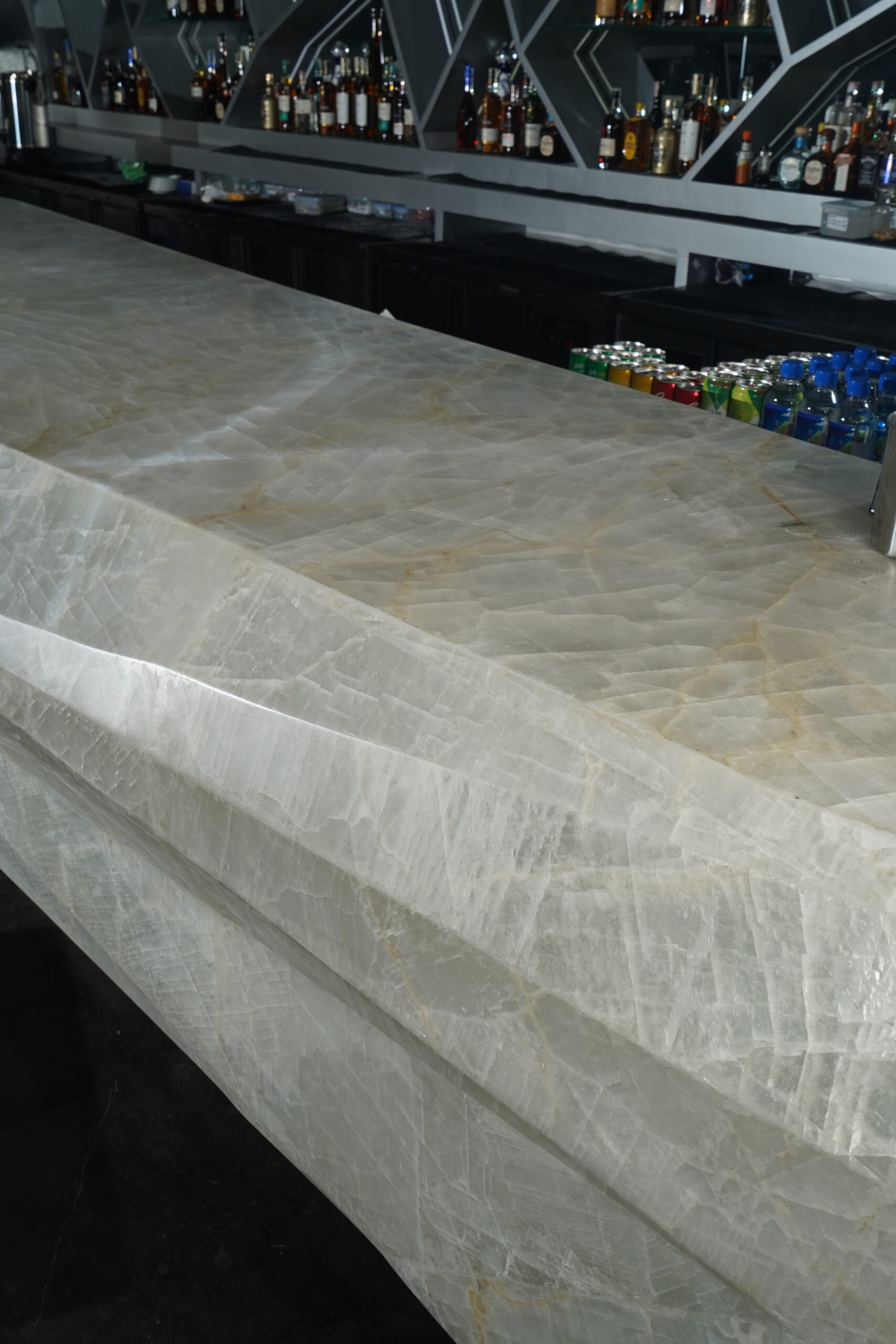
- Bar tops. A bar is where onyx is most at home. At H List in Jakarta’s SCBD, MM Galleri laminated Onyx Ice Age at 8mm for the bar and tables, lit from below so the whole surface glows. Every piece was prefabricated in our factory before installation. A bar top will gather marks from citrus and spirits over time; in a room lit for atmosphere they read as character, and a specialist can re-polish the surface when needed.
- Vanities and powder rooms. Onyx suits a bathroom surface that is seen more than worked. At YD House, polished Onyx Africa, with its caramel, honey and ivory veining, was used as the statement surface in the bathroom. Keep perfumes, toiletries and acidic cleaners on a tray rather than on the stone.
- Backlit feature counters. Reception desks, display counters and sideboards gain the most from onyx’s translucency. Our onyx backlighting guide explains how to light a panel evenly.
- Tables and occasional surfaces, where the load is light and spills are wiped straight away.
Where should you avoid onyx?
The honest answer is the working kitchen, the place onyx countertops are most often requested and least often happy. Food preparation brings knives, acids, oils, heat and constant wiping, and onyx will show all of them within weeks. Heavy commercial counters where keys, bags and cash trays slide across the top every few minutes are a similar case. Exterior use is also best avoided: sun and weather can dull the polish, and the resins used in many slabs can yellow under strong UV.
There is a good middle path for reception desks and islands: use onyx for the lit front panel, where it can glow undisturbed, and a harder stone for the working top.
How do you protect an onyx countertop?
Care for onyx countertops is mostly habit.
- Seal it. A good impregnating sealer slows staining, though it does not prevent etching. Ask your fabricator which sealer suits the specific slab and its resin.
- Use coasters, trays and trivets. Glasses, bottles, toiletries and anything hot should never sit directly on the stone.
- Wipe spills at once. Use a soft cloth and a pH-neutral cleaner. Avoid vinegar, lemon-based products, bathroom descalers and anything abrasive.
- Consider a protective layer on hard-used bars. Some owners fit a clear protective film or a glass top over an onyx bar, trading a little of the tactile quality for peace of mind.
- Plan for occasional re-polishing. Etch marks and fine scratches on onyx can usually be polished out by a stone specialist.
What are the alternatives if you love the onyx look?
If the room needs a working surface with the spirit of onyx, there are several honest options.
Laminated onyx is the closest. MM Galleri’s 8MM technique, developed in 2002, slices stone to 8mm or thinner and bonds it to a backing such as glass, which gives a thin onyx panel far more support and makes it ideal for backlit bars and furniture. It remains onyx on the surface, so it still needs the same care.
Some quartzites are translucent enough to be backlit, and they are much harder than onyx and do not etch in the same way. Onyx-look sintered and porcelain surfaces offer the colour and banding with very high resistance to scratches, stains and heat, though without the same depth of light. Our comparison of onyx and marble sets out how onyx sits against its closest natural relative, and the onyx collection shows the range of colours available.
Onyx countertops and their alternatives compared
| Surface | Look | Translucency | Scratch and etch resistance | Best for |
|---|---|---|---|---|
| Natural onyx slab | Banded, deep, luminous | High | Low; scratches and etches easily | Bar tops, vanities, feature counters |
| Onyx laminated to glass (8MM) | Same as natural onyx | High, even when backlit | Low on the face; far better supported | Backlit bars, furniture, lit panels |
| Marble | Veined, soft glow when polished | Low to none | Low to moderate; etches | Kitchens that accept patina, bathrooms |
| Translucent quartzite | Veined, crystalline | Moderate on some varieties | High; does not etch like calcite | Working islands with a lit front |
| Onyx-look sintered or porcelain | Printed banding, consistent | None | Very high | Working kitchens, commercial counters |
Frequently asked questions
Can you use onyx for a kitchen countertop?
You can, but it is rarely wise for the working part of a kitchen. Onyx scratches easily, etches with acids such as lemon and wine, and its resin fill can mark under heat. It suits a kitchen as a bar top, a lit island front or a serving counter used lightly, alongside a harder stone where the cooking happens.
Is onyx harder to maintain than marble?
Yes, somewhat. Both are calcite and both etch with acids, but onyx is more brittle, more often fissured and usually polished, so marks show more clearly. It needs coasters, trays, prompt wiping and occasional professional re-polishing. Marble tolerates daily use a little better and wears into a patina more gracefully.
Can an onyx countertop be backlit?
Yes, and that is where onyx is at its most beautiful. The counter needs a translucent build: a slab without a mesh that would show as a grid, often laminated to glass for support, with LED lighting spaced evenly behind it. Plan the lighting, access for maintenance and the heat of the fittings from the start.
Does onyx need to be sealed?
Sealing is recommended. An impregnating sealer reduces how quickly oils and coloured liquids soak into the stone, particularly along fissures and resin lines. It does not stop acids from etching the surface, so coasters and prompt wiping still matter. Your fabricator can advise which sealer suits the slab and how often to reapply it.
Onyx asks for a considered place and a gentle hand, and in return it offers something no harder surface can: stone that holds light like a lantern and turns a bar or a basin into the room’s quiet centre of gravity.