
Purple marble is natural marble marked in violet, lilac or wine, usually on a white or grey ground. The best known are Calacatta Viola and the Tuscan violet breccias, Calacatta Paonazzo, Arabescato Violet and Lilac White. The colour comes from minerals in the rock. It is at its best on one deliberate surface: a vanity, an island, a fireplace.
For years the default request for kitchens and bathrooms was white marble with soft grey veins, as quiet as possible. That is changing. Designers are asking again for stone with colour in it, and the colour they ask for most is purple. It is worth knowing what these stones are before falling for a photograph.
What makes a marble purple?
Marble begins as limestone. Under heat and pressure, deep in the earth, its calcite recrystallises into the dense, glittering stone we cut and polish. Pure calcite is white. Every other colour in marble comes from something else that was present in the rock: clay, iron, manganese, graphite, organic matter.
Suppliers of the violet Tuscan marbles generally attribute their colour to iron and manganese oxides held in the stone. The amount and the distribution vary from metre to metre inside a quarry, which is why one block can be pale lilac and the next a deep wine red.
Many of the boldest purple stones are breccias. A breccia is a rock that was shattered into angular fragments and cemented back together. When it becomes marble, the fragments stay pale and the cement between them carries the colour, so you get white islands outlined in violet.
Is purple marble a new idea?
Not at all, and the history is part of the appeal. The Romans prized a purple-veined stone called Pavonazzetto, quarried at Docimium in Phrygia, in what is now Turkey. Its extraction was controlled by the imperial administration, and it was laid in the floor of the Pantheon in Rome.
In sixteenth-century Florence, Grand Duke Cosimo I de’ Medici held the monopoly on the marble quarries of Seravezza in Tuscany. One of their stones, a purple breccia, still carries his family’s name: Breccia Medicea. It was used in the choir of Florence Cathedral, among other places.
The most famous purple stone of antiquity, imperial porphyry from Egypt, is a different case altogether. It is an igneous rock, not marble, and Roman emperors reserved it for themselves.
Why are designers choosing coloured marble again?
Design magazines have been tracking a turn away from pale, minimal countertops towards stone with strong veining and real colour. House Digest has described bold kitchen surfaces taking over from minimalist ones through 2026, and named Calacatta Viola among the marbles expected in luxury bathrooms that year.
Interior designers have gone further than a countertop. In coverage of the 2025 Kips Bay Palm Beach Show House, Luxe described a powder room where a designer painted the plaster walls deep purple to pick up the veins of Calacatta Viola.
Our reading is simple. After years of white kitchens, many people want a room that could only be theirs. A slab of violet breccia is never repeated, and it carries warmth that grey veining does not.
Which violet marbles are there?
The names below are all in our collection. Trade names are loose, so treat the descriptions as a guide to how each name is generally used, and judge the slab in front of you.
| Stone | Ground | Markings | Character |
|---|---|---|---|
| Calacatta Viola | Bright white | Violet and grey veining, flowing in some blocks and broken in others | The Italian original; superb bookmatched |
| Breccia Violetta | Pale, often lilac-tinged | Violet and lilac fragments and seams | A softer-toned breccia |
| Calacatta Paonazzo | White | Violet veining, sometimes with warmer gold or reddish tones | “Paonazzo” is an Italian word for a purple shade |
| Arabescato Violet | White | White fragments packed in wine and plum seams | From Turkey; bold, and more affordable than Calacatta Viola |
| Lilac White | Bright white | Soft lilac and grey veining | The quietest of the group |
| Violetta Grey | Grey | Violet in the markings | Cooler, more subdued |
| Onyx Violet | Onyx, not marble | Violet tones | Onyx can be backlit where the slab allows |
For a closer look at individual stones, see Calacatta Paonazzo, Lilac White and Violetta Grey online, then come and see the slabs.
Where does violet-veined marble work best?
On surfaces you look at rather than walk across. A violet breccia rewards attention, so place it where attention naturally falls.
Powder rooms and vanities. A small room clad in one stone, floor to ceiling, is the most confident use of a bold breccia. A single vanity top with a full-height splashback behind it gives much of the same effect with far less stone.
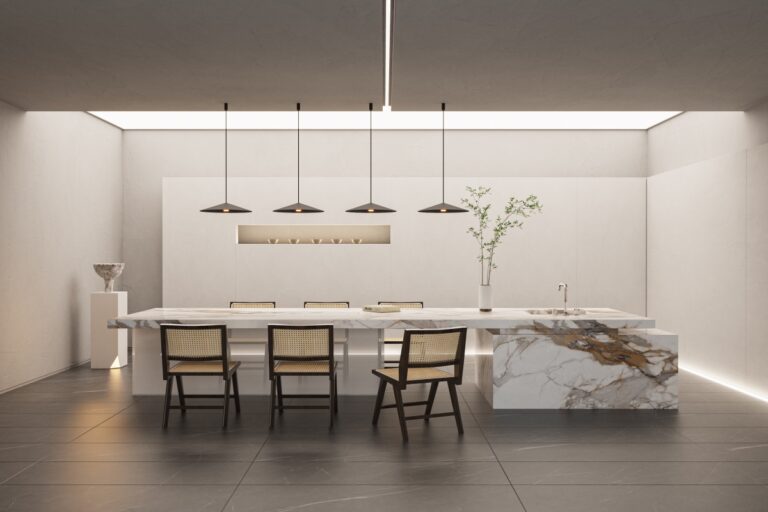
Kitchen islands. A purple island against quiet cabinetry becomes the centre of the room. If the stone runs down the sides to the floor, the veining appears to wrap around the corners.
Fireplaces and bar fronts. Vertical, framed and lit, they show colour without the wear of a worktop.
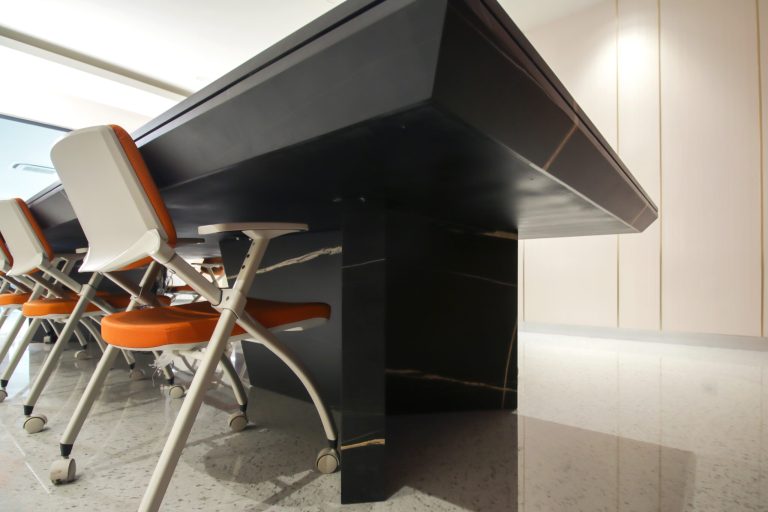
Furniture. Dining tables, side tables and consoles let a family live with a statement stone without committing a whole room to it.
For walls and furniture where weight matters, our 8MM technique laminates stone thin to glass, wood or metal, so a violet marble can clad a surface that could not carry a solid slab.
What goes with violet veining?
These stones are more forgiving than their reputation. Warm metals such as brass and bronze pick up the wine tones. Walnut and other dark timbers sit well beside it. Deep green, in paint, velvet or a second stone, is a classic partner.
Light changes these stones more than it changes white marble. Warm evening light pushes the veins towards red; cool daylight pulls them towards lilac. Look at a sample in the room it is meant for, at the time of day you will use it most.
Finish matters too. Polish deepens the colour and sharpens contrast. A honed surface lifts the colour and softens it, which some clients prefer on a kitchen worktop.
How should you choose a slab of violet marble?
In person, and with the whole slab in view. Photographs flatten colour, and violet is the hardest colour for a camera to get right.
Ask to see slabs from the same block if the job needs more than one, so the colour stays consistent. If you want a mirrored pattern on a wall, ask for bookmatched slabs: two consecutive slices opened like a book. We prepare bookmatched slabs and finish edges in our own workshops before installation.
Like all marble, these stones are calcite, so acids in wine, lemon or vinegar can etch the surface. For kitchens, StainZero, our own factory-applied coating for natural stone, adds resistance to scratches, heat and strong acids.
FAQ
What is purple marble called?
There is no single name. The most common are Calacatta Viola, Breccia Viola or Breccia Violetta, Breccia Medicea, Calacatta Paonazzo, Arabescato Violet and Lilac White. Calacatta Viola is Italian, while Arabescato Violet comes from Turkey and costs less. Traders use the names loosely, so always look at the slab and ask where the block was quarried.
Is purple marble natural or dyed?
Natural. The violet colour comes from mineral traces in the rock, generally attributed to iron and manganese oxides in the Tuscan breccias. It runs through the stone rather than sitting on the surface, which is why it varies from block to block and why no two slabs look the same.
Is purple marble suitable for a kitchen?
Yes, with the same care as any marble. It suits an island or a single run of worktop well. Acids from lemon, wine or vinegar can etch any calcite marble, so wipe spills promptly. A factory-applied protective coating such as StainZero adds resistance for a hard-working kitchen.
Can purple marble be used outdoors?
Some marbles are used outdoors when the type and the finish are right, on terraces, facades or around pools. Granite is the easier outdoor choice in general. Whether a particular violet marble suits your site depends on the stone and the exposure, so ask our team before you specify it.
Does violet marble go out of style?
Purple stone has been prized since Roman times, and the Medici used violet breccia in Florence five hundred years ago. Fashion will move, but a stone with this history rarely looks dated. Use it on one deliberate surface rather than everywhere, and it will hold its place.
Millions of years in the making. Finished in our own workshops.