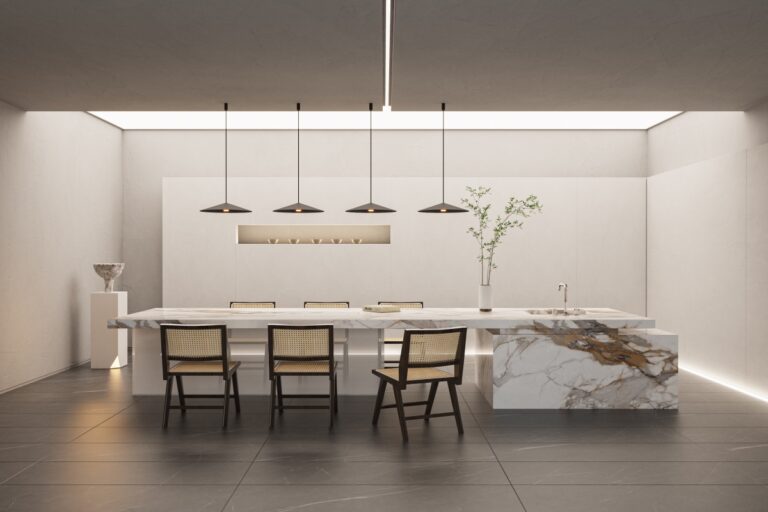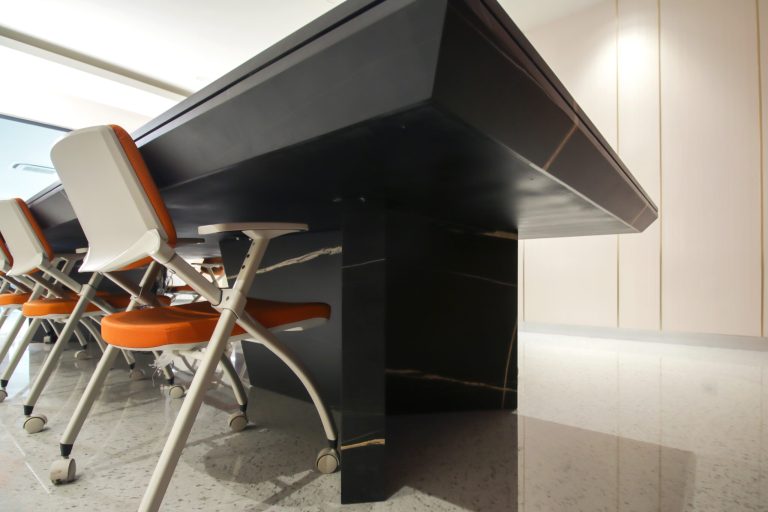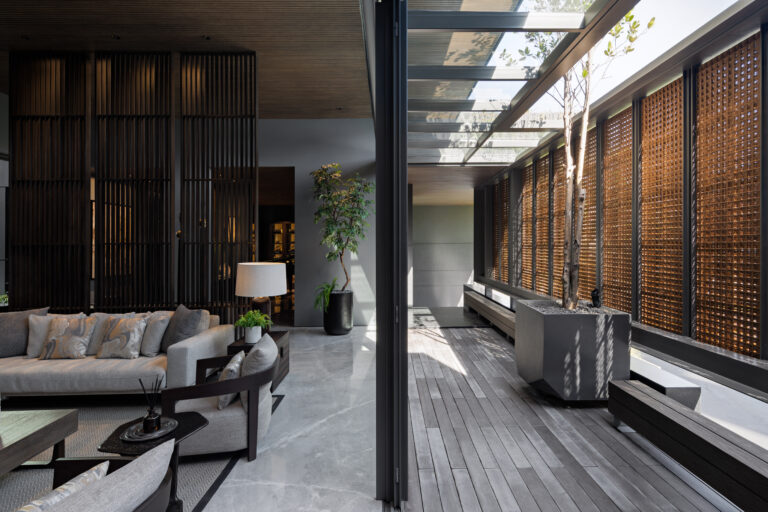
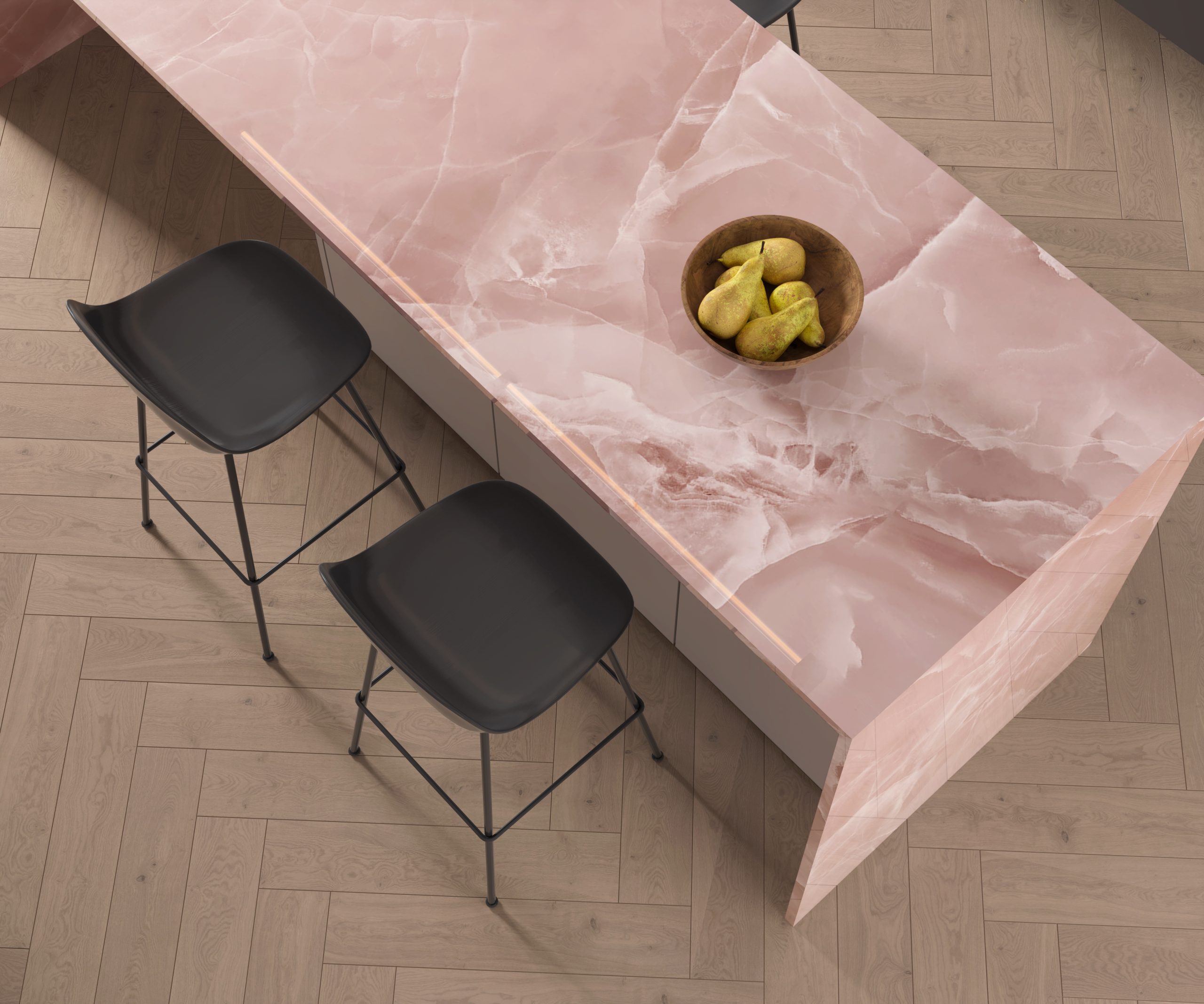
Translucent Full Body is the factory name for the body of SINISO’s semi-translucent Luxury colours. They sit in Full Body, one of four collections alongside Speckled Body, Coloured Body and Onyx. Colour and veining run from the face to the back. At a full 12 mm, light also passes into the slab, where most translucent sintered stones need 3–6 mm.
Most people choose a surface by its face. This piece is about everything else: the edge, the back, and the material in between, which is what the word “body” describes.
What does “body” mean on a stone slab?
The body is the material under the surface. It is what you see at a slab’s edge, and what you would see if you turned it over.
With natural marble the question hardly arises. A marble vein is a seam of mineral that formed inside the rock, so it runs through the full thickness of the slab. Cut the stone anywhere and the vein is there.
Surfaces that are made rather than quarried are different. What lies under the face is a decision the maker takes.
On some slabs the pattern is applied to the face, and the body beneath is a plain material of another colour. On others, the pattern runs through. The word “body” is how makers tell you which one you are buying.
What are SINISO’s four collections?
SINISO is sintered stone: minerals pressed and fired into one dense body, by New Jincheng Group. It contains no resin and no crystalline silica. In Indonesia, MM Galleri selected 63 colours, in four collections.
Full Body. Colour and veining run from the face to the back. Cut, mitre or round the edge and the stone carries on. Eighteen colours.
Speckled Body. The body is coloured and lightly speckled to follow the surface tone: beige, grey or black. Edges and chips stay discreet. It suits hard-working floors, worktops and walls. Eleven colours.
Coloured Body. Super-white and beige bodies sit under marble, limestone and travertino designs. The brightest whites and the clearest glazes are here. Thirty colours.
Onyx. Four onyx designs with the depth and glow of the natural stone. Two sit on a semi-translucent body that comes alive when lit from behind; two carry a crystal-polished glaze on a super-white body.
| Collection | What runs through the slab | What the edge shows | Colours for Indonesia |
|---|---|---|---|
| Full Body | Colour and veining, face to back | The same vein, carried over the edge | 18 |
| Speckled Body | A tinted, lightly speckled body | A body that follows the surface tone, so chips stay discreet | 11 |
| Coloured Body | A super-white or beige body | A bright base, finished, mitred or polished to suit | 30 |
| Onyx | A semi-translucent or super-white body | Depends on the design: ask to see its edge | 4 |
Where does Translucent Full Body fit?
Inside Full Body. Not every Full Body colour is semi-translucent: only the Luxury colours are.
The factory calls the body of those colours Translucent Full Body. It carries two promises at once.
The first is depth: through the body, to the edge. The vein crosses a mitred corner and carries on.
The second is light. Placed in front of a light source, the slab glows. The brand line for it is “Light, held in stone.”
Why does it let light in at 12 mm?
Because of the body itself. With the right minerals, the slab leaves the kiln pure enough to let light in.
Thickness is the usual obstacle. Most translucent sintered stones must be cut down to 3–6 mm before light passes through.
These colours do it at a full 12 mm, the same thickness as every other SINISO slab. A designer does not have to choose between a slab that glows and a slab with an edge worth showing.
Why say semi-translucent if the name says translucent?
Because a factory name is not a measurement. The name is what the body is called. Semi-translucent is the accurate description of how it behaves.
Light passes into the slab and the face glows. Objects behind it stay hidden. Calling it simply “translucent” can suggest light passing almost freely, and we would rather a client be pleasantly surprised by a lit sample than disappointed by a word.
How much light comes through also depends on the light source: its brightness, its colour, its distance and how evenly it is spread. Judge it on a lit sample, never on a photograph.
Is every SINISO colour semi-translucent?
No, and this matters more than any other point in this piece. Only the Translucent Full Body colours, and two of the Onyx designs, are semi-translucent.
The other Full Body colours carry their veining through the slab, but they are not lit from behind. Coloured Body colours are chosen for the beauty of their face and finish, not for depth or light.
If a design relies on light, name the colour and see it lit before anything goes into a drawing.
Why does the body matter more than the face?
Because a kitchen, a bathroom or a wall is not only a flat face. Wherever the thickness of a slab shows, the body is on display.
Think of the visible edge of a counter, the corner where two panels meet, the end of an island seen from across a room, or the reveal around an opening.
The difference is small in a photograph of the face and large in the finished room. It is also very hard to correct once the stone is installed.
How does full body differ from a printed surface?
On a printed surface, the pattern is applied to the face. It can look convincing from above, and for a flat panel with hidden edges it may be all you need. The trouble begins at the edge, where the print stops and the body begins.
Full body surfaces are a relatively recent development. In 2019 one maker, Lapitec, announced what it described as the world’s first sintered stone slabs with veining running all the way through. The direction since then has been the same: make the inside of the slab worth seeing.
How should you inspect a full body sample?
Treat it the way a stone mason treats a slab of marble: from every side.
- Look at the face in daylight and under the light the room will have.
- Turn the sample and look straight at the edge. Does the vein continue, or does it stop?
- Ask to see a mitred corner. On Full Body, the vein should turn it.
- For a semi-translucent colour, ask to see it lit from behind.
- Put the collections side by side. The differences are clearest at the edge.
- Bring your drawings, and mark every place an edge will show.
Always approve a physical sample before ordering.
Which body should you choose?
Our position is simple. If an edge will be seen, start with Full Body and only move away from it for a reason. If the slab will be lit from behind, choose one of the semi-translucent colours.
If the surface is a floor or a busy worktop, look hard at Speckled Body. If what you want is the cleanest, brightest white, look at Coloured Body.
Every slab measures 1600 × 3200 × 12 mm, so most of these decisions can be made at the drawing stage, before anything is ordered.
For a wider introduction, see our SINISO page. For the natural stone that has always glowed, our guide to backlighting onyx sets out the principles of lighting stone from behind. And if you are still comparing natural and made surfaces in general, start with what engineered stone is.
Frequently asked questions
What is Translucent Full Body?
It is the factory name for the body of SINISO’s semi-translucent Luxury colours, within the Full Body collection. Colour and veining run from the face to the back, and the slab lets light in at a full 12 mm. Most translucent sintered stones need 3–6 mm before light passes through.
Does light pass through the whole slab?
Light passes into the slab and makes the face glow, but objects behind it stay hidden, which is why we call it semi-translucent. How strongly it glows depends on the light source, its distance from the slab and how evenly the light is spread. Judge it on a lit sample, never on a photograph.
What are SINISO’s four collections?
Full Body, Speckled Body, Coloured Body and Onyx. Full Body carries colour and veining from face to back. Speckled Body is tinted and lightly speckled, so edges and chips stay discreet. Coloured Body puts super-white and beige bodies under marble, limestone and travertino designs. Onyx holds four onyx designs. In Indonesia they cover 18, 11, 30 and 4 colours.
Is every Full Body colour semi-translucent?
No. All Full Body colours carry their veining through the slab, but only the semi-translucent Luxury colours let light in. If a design depends on light, choose one of those colours by name and see it lit before specifying.
What size are SINISO slabs?
Every slab measures 1600 × 3200 × 12 mm, whatever the body. A fixed format lets you decide at the drawing stage where joints and visible edges will fall, and which body each of them needs. Natural stone is different: its slab size varies from block to block.
Choose the body for the edge, and the face will look after itself.