A stone fabricator in Indonesia cuts, shapes and finishes natural and engineered stone into ready-to-install pieces for projects at home and abroad. MM Galleri has done this in its own Surabaya factory since 1992: custom tops and furniture, decorative edges, waterjet inlay, bookmatched walls, 8MM laminated panels and StainZero-protected stone, prefabricated before they ship.
Type “stone fabricator Indonesia” into a search bar and you will find suppliers, traders, quarries and workshops, often described with the same words.
For an architect in Sydney, a developer in Dubai or a furniture brand in Europe, the difference matters. A trader sells slabs. A fabricator takes responsibility for what those slabs become. This guide explains what to look for, and what a Surabaya workshop can make.
What does a stone fabricator actually do?
A fabricator stands between the slab and the building. It selects the stone, reads the drawings, lays out the veining, cuts, shapes edges and openings, finishes the surface, protects it, checks the pieces together and packs them for the journey.
That last part is easy to underestimate. A slab can be shipped almost anywhere. A finished, numbered set of pieces for a bar, a lobby or a staircase, ready to set in place on arrival, is a different product. It carries the workshop’s judgement inside it.
Why work with a fabricator in Indonesia?
Three reasons come up most often with overseas designers.
- Stone and workshop under one roof. A fabricator that also holds a large stock of slabs can match pieces from the same block, and change a slab if one is not right, without waiting on a second supplier.
- Hand skill alongside precision cutting. Indonesia has a long tradition of hand-finishing in stone and wood. Custom pieces, edges and inlays still depend on hands at the finishing stage.
- A position in Asia. For projects in Southeast Asia, Australia and the Middle East, an Indonesian workshop is a practical starting point for finished stone.
None of this is a reason to choose a fabricator by country alone. Choose by what the workshop can show you.
What can a Surabaya stone workshop make?
At MM Galleri, pieces are cut, finished and prefabricated in our own workshops before installation. What leaves the factory falls into a few families.
Custom tops, vanities and furniture
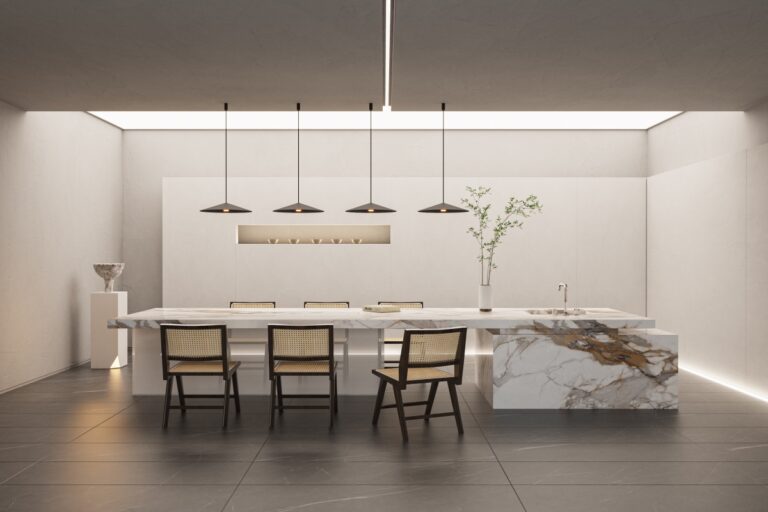
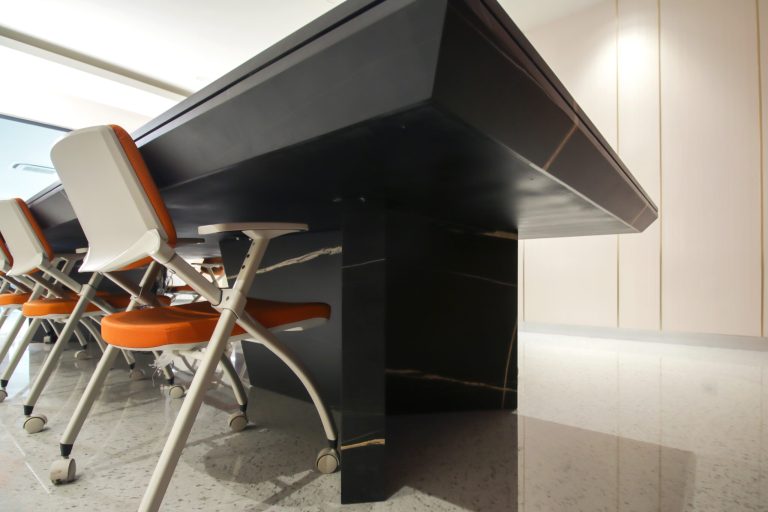
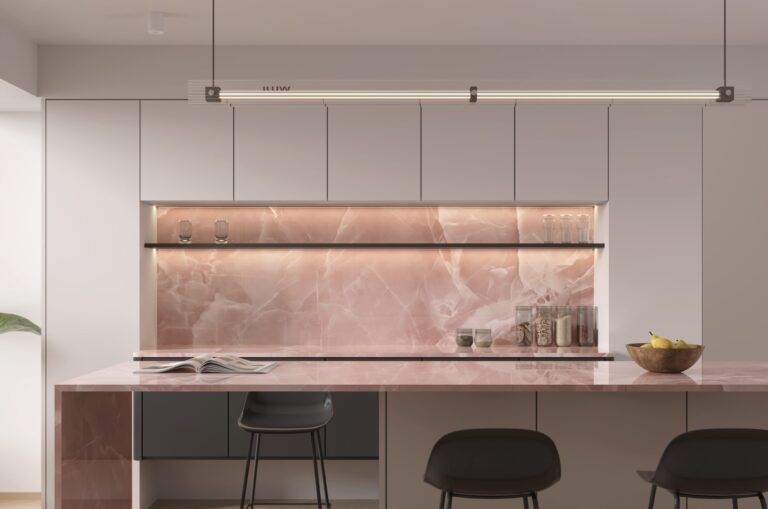
Kitchen tops and islands, bath vanities, tables and bar counters, made to drawings and finished on every visible face. Our collection holds more than 400 types of marble and more than 100 types of granite, as well as onyx, travertine and quartzite. We also carry engineered surfaces such as Lapitec, Dekton, Silestone and Vicostone, and SINISO sintered stone.
Decorative edges
The edge profile is where stonework shows its care. We cut and finish decorative edges, including triple bullnose, in our own workshops, alongside quieter profiles such as pencil and eased edges.
Fluting, inlay and bookmatching
The fluted stone railing in our Alam Sutera showroom in Jakarta was made in our factory. Waterjet inlay, such as the lotus medallion floor at Maha Vihara in Surabaya, sets pieces of coloured stone together with hairline joints. Bookmatched slabs, mirrored like the pages of a book, turn a wall into one continuous figure.
Thin, curved and textured stone
These are the techniques developed in Surabaya over three decades:
- 8MM (since 2002): stone sliced thin and laminated to glass, wood or metal. See the 8MM page.
- Sierra, or Natural Marble Skin (2008): a sculpted, rock-like surface on natural stone.
- Bended (2016): curved stone, 60% lighter than solid marble, patented in Southeast Asia.
- Silhouette (2020): stone artworks.
- Lithoglaze: glazed lava stone in solid pieces.
Protected stone for long journeys and hard use
StainZero, introduced in 2024, is MM Galleri’s own factory-applied coating for any natural stone, made to resist scratches, heat and acids. Because it is applied in the factory, it is part of the finished piece when it leaves.
How does prefabrication help an overseas project?
When pieces arrive finished, the site does less. Joints have been planned, edges are profiled, openings are cut, and the veining has been laid out across the set. The installer sets, bonds and levels, rather than cutting and polishing in a room full of other trades.
It also moves the decisions earlier, to where they are cheaper. A layout approved on the slab in Surabaya costs nothing to change. The same change on site, after the stone has crossed a sea, costs a slab.
What should an export buyer ask a stone fabricator?
These are the questions worth asking any workshop, in Indonesia or elsewhere:
- The actual slabs. Ask for photographs or video of the specific slabs, with block and slab numbers visible.
- Shop drawings. Ask who draws them. Every piece should be drawn, numbered and approved before cutting.
- The vein layout. For bookmatched walls, waterfall islands and long counters, ask to approve the layout on the slab.
- Edges and openings. Edges, cut-outs and backs that will be seen should match the face.
- The dry-fit. Ask for photographs of the pieces laid out together before packing.
- Packing. Stone should travel crated and on edge. Wooden crates for international shipping must meet ISPM 15, the international standard for treated and marked wood packaging.
- Protection. A sealer, or a factory coating such as StainZero, should be named in writing.
- Spare stone. A small amount of spare material from the same block makes later repairs far easier.
Fabrication checklist for overseas buyers
| Item to agree | Why it matters | What to receive |
|---|---|---|
| Slab approval | Natural stone varies block to block | Photos or video with slab numbers |
| Shop drawings | Every piece numbered and dimensioned | Signed drawing set |
| Vein layout | Decides how the finished piece reads | Layout on slab photographs |
| Edges and finish | Edges show care, or its absence | Edge sample or photograph |
| Protection | Sealer or factory coating | Product named in writing |
| Dry-fit | Problems are cheapest found in the workshop | Photographs before packing |
| Packing | Stone breaks when shipped flat | Crated on edge, ISPM 15 wood |
| Spare stock | Repairs need the same stone | Quantity agreed in advance |
Can I see the work before I order?
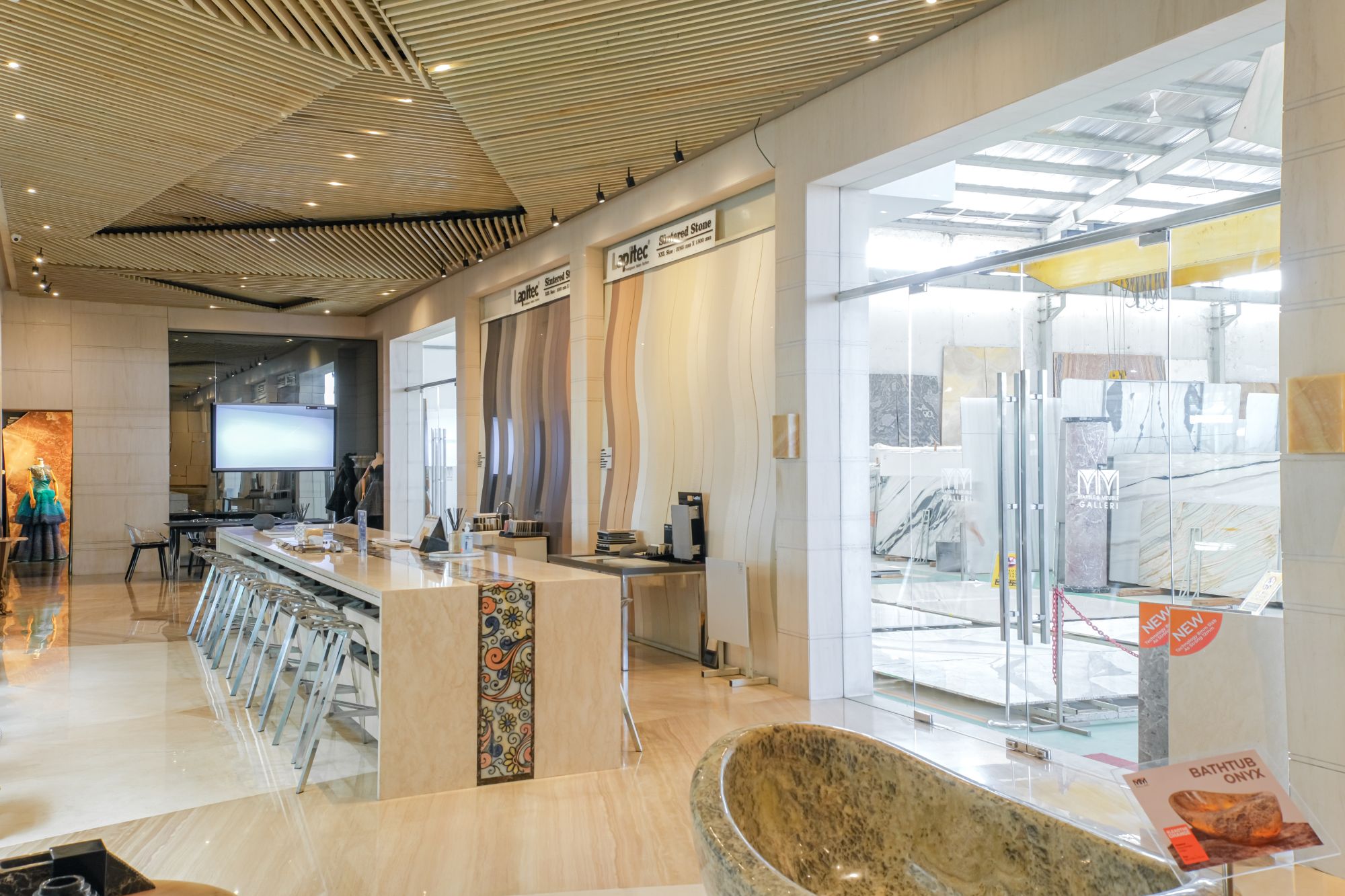
Yes, and you should. Our showrooms in Surabaya, Jakarta (Alam Sutera and IDD PIK 2), Bali and Singapore show the stones and the techniques side by side. The Singapore showroom is the closest for many overseas designers, and our export page is the place to start a conversation about a project abroad.
Frequently asked questions
What is the difference between a stone supplier and a stone fabricator?
A supplier sells stone, usually as blocks or slabs. A fabricator turns slabs into finished pieces: it cuts, shapes edges and openings, finishes and protects the stone, and packs it ready to install. Many companies do one or the other. A workshop that does both can match pieces from the same block and replace a slab without a second supplier.
Can stone be fabricated in Indonesia and installed abroad?
Yes. Finished pieces are drawn, numbered and approved before cutting, then crated on edge and shipped as a set, ready to be set, bonded and levelled on site. The more work done in the factory, the less is left for the site, which is where cutting and polishing are slowest and most disruptive.
Does MM Galleri work with engineered stone as well as natural stone?
Yes. Alongside more than 400 marbles and more than 100 granites, our collection includes engineered surfaces such as Lapitec, Dekton, Silestone and Vicostone. It also includes SINISO, sintered stone by New Jincheng Group. In Indonesia, SINISO is selected and distributed exclusively by MM Galleri.
What is 8MM laminated stone?
8MM is MM Galleri’s technique, developed in 2002, of slicing natural stone thin and laminating it to glass, wood or metal. It brings real stone to furniture and wall cladding where a solid slab would be too heavy, with the stone itself on the surface rather than a printed image of it.
Millions of years in the making. Finished in our own workshops.