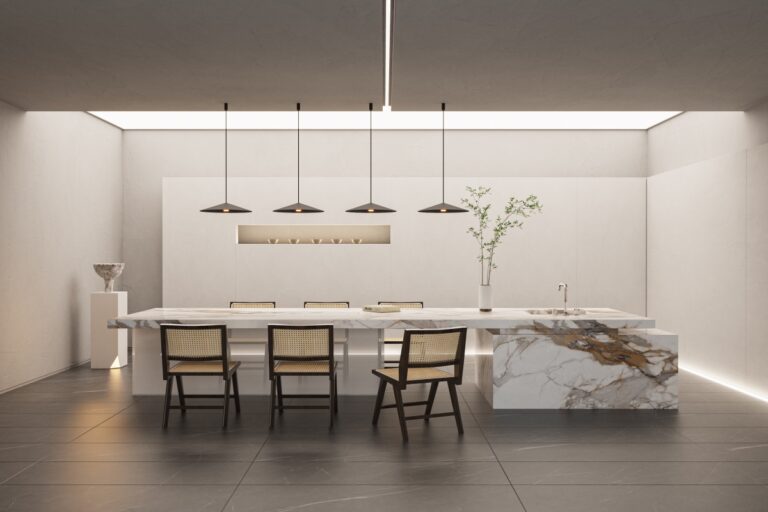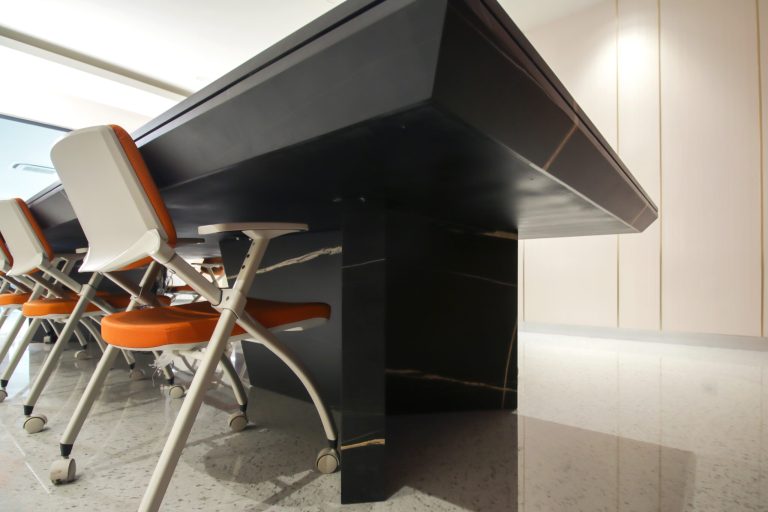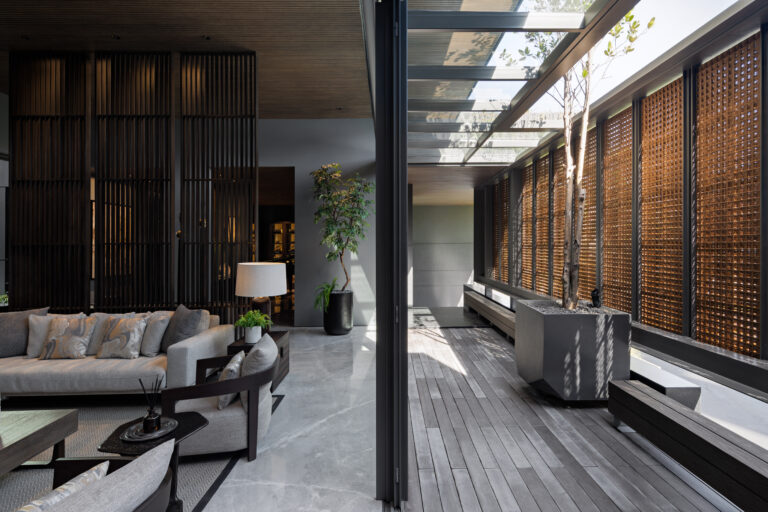
Arabescato Violet and Calacatta Viola are both white marbles marked in purple, but they are different stones. Arabescato Violet is quarried in Turkey; Calacatta Viola is the Italian original. Italian blocks vary, from flowing violet bands to broken white pieces, but the Turkish stone’s seams are wider and warmer. The Italian stone also costs more.
Both names arrive on the same shortlists, usually because someone has seen a photograph of a purple-veined kitchen and wants “that one”. At thumbnail size the two look alike. On a slab, and on a quotation, they do not.
Why are these two purple marbles so easy to confuse?
Partly because of the photographs. Any white stone with purple in it looks similar on a phone screen. Partly because of the names. Stone trade names are not registered the way a wine appellation is, and the same look can be sold under different names by different traders.
Calacatta Viola is the name with the reputation. Because the Italian stone costs more, the Turkish one is often offered in its place, and the line between the two names gets blurred. The word “Arabescato” adds to the confusion: it comes from the Italian trade, where it describes a busy, arabesque-like pattern, so the name sounds Italian even though the stone is not.
The first question to ask any seller is simple: is this block from Italy or from Turkey?
What does Arabescato Violet look like?
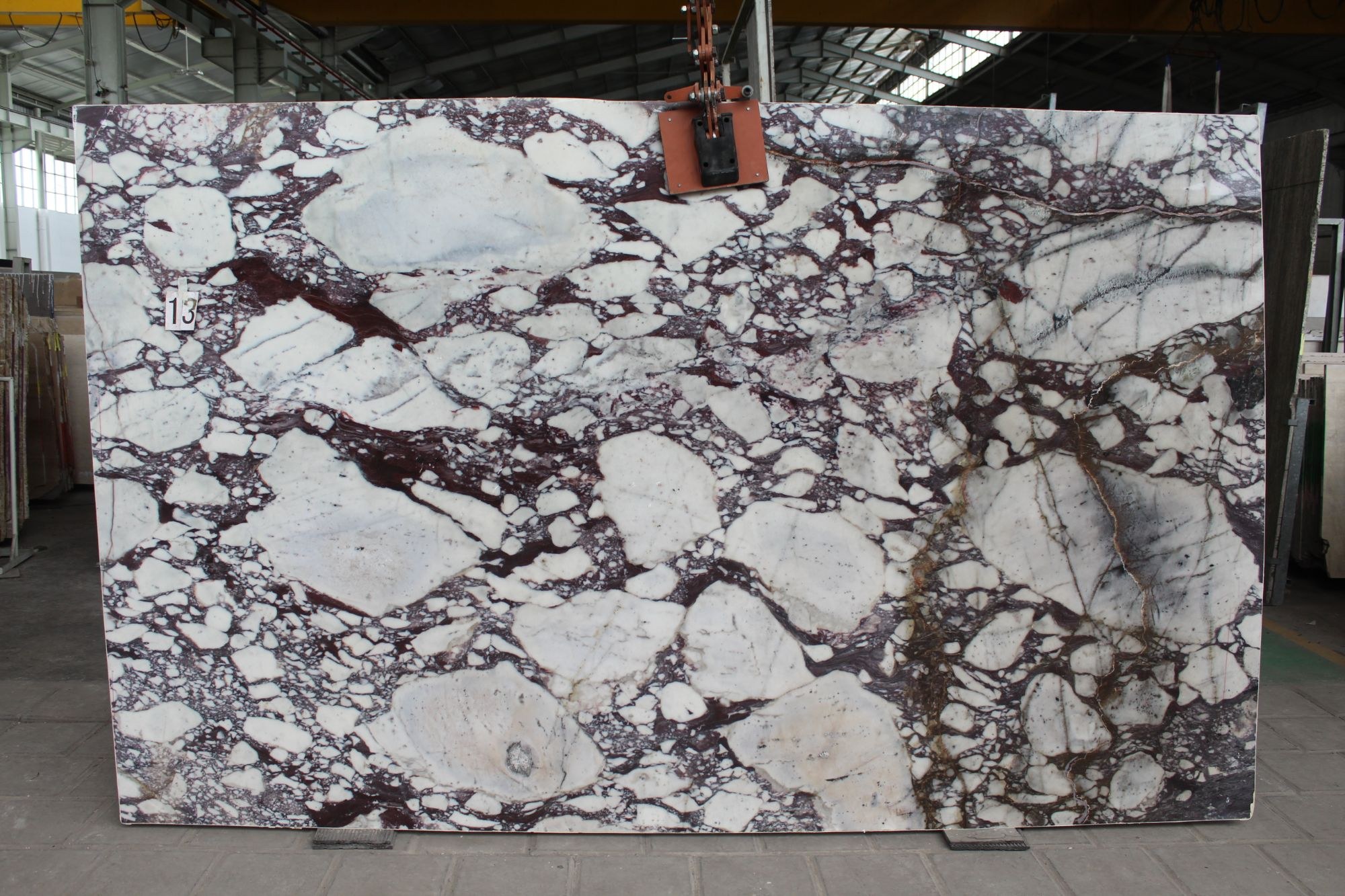
Arabescato Violet looks like a breccia. Its white and pale grey pieces, some the size of a coin and some larger than a hand, are packed tightly together and outlined in dark seams. The seams run from wine-red through plum to aubergine, and in some slabs a thin gold-brown vein crosses the pattern.
The effect is graphic and busy. The colour sits in a dense network around the white pieces rather than in one direction of movement, so the slab reads as a mosaic. From across a room it is high in contrast.
What does Calacatta Viola look like?
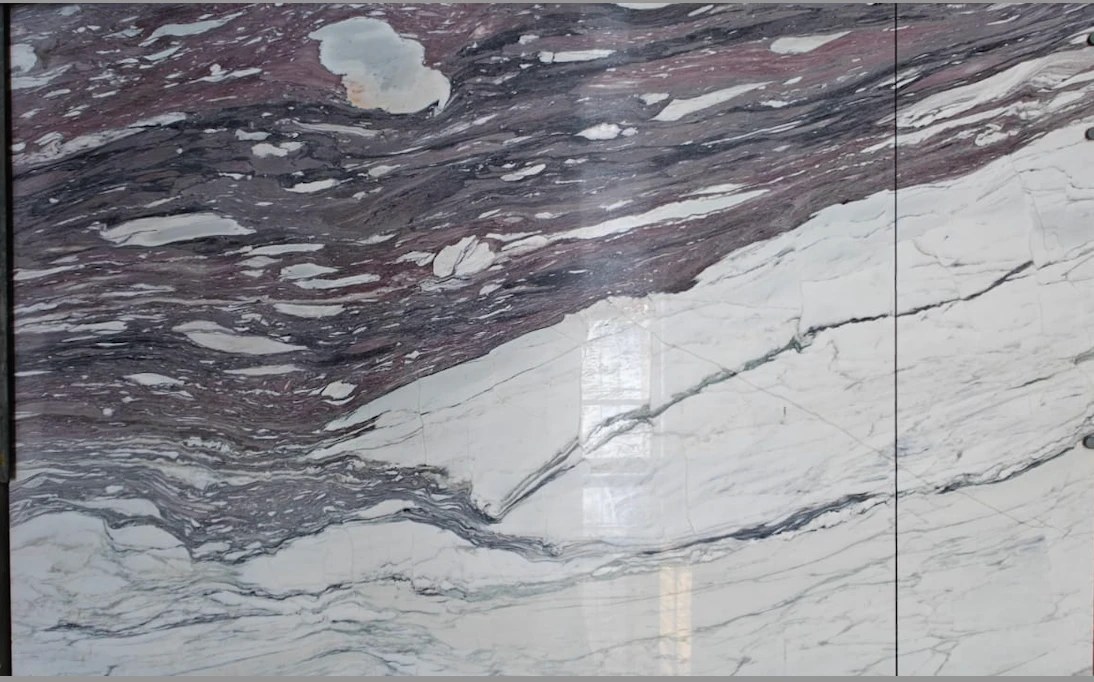
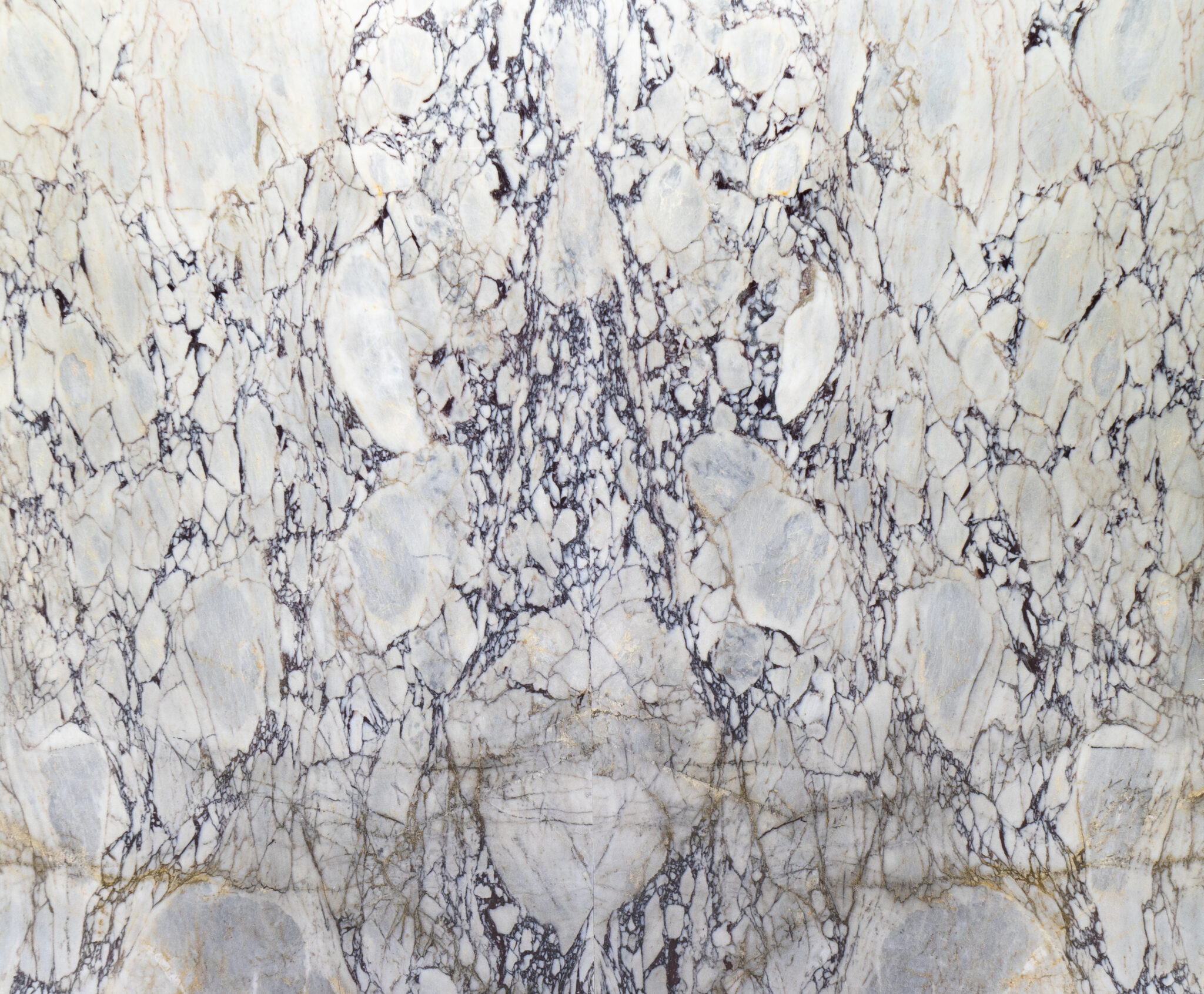
No two blocks of the Italian Calacatta Viola are alike, and both slabs above are the real thing. Some blocks move: wide bands of plum, violet and soft grey sweep across the slab like a current, carrying stretched white pieces with them. Others break up into large white and pale grey pieces, outlined by thin veins of dark violet and grey.
What the Italian blocks share is the ground: a bright, cool white, with violet that leans towards grey rather than red. Both kinds bookmatch well. A flowing block opens into a mirrored figure with a clear centre line; a broken block opens into a symmetrical pattern of pieces.
How do you tell them apart in a slab yard?
Not by pattern alone. A broken block of Calacatta Viola and a slab of Arabescato Violet can look alike from across a room, so step in and look at the seams. The table below sets out Arabescato Violet vs Calacatta Viola point by point. Treat it as a guide, not a rule for every block: always judge the slab in front of you, and ask where it was quarried.
| What to look at | Arabescato Violet | Calacatta Viola |
|---|---|---|
| Origin | Turkey | Italy, the original |
| Pattern | Packed white fragments in a dense network of seams | Varies by block: flowing bands, or large white pieces in thin veins |
| Seams | Wide and warm: wine, plum and aubergine, filling the gaps between pieces | Thinner and cooler: violet, grey and near-black |
| White ground | Broken into many small pieces | Large areas of bright, cool white |
| How it reads from across a room | Busy, graphic, high contrast | Flowing or broken, with more white showing |
| Price | The more affordable of the two | Costs more |
The best test is the colour of the seams. Stand the two side by side in daylight. If the purple leans towards red wine and fills the spaces between the white pieces, you are probably looking at the Turkish stone. If it leans towards violet-grey and leaves more white showing, it is more likely Italian. In the end, the quarry named on the quotation is the only sure answer.
Why does the price differ?
The two stones come from different quarries in different countries, and the Italian one carries the original name and the longer reputation. Calacatta Viola is the scarcer and more sought-after of the two, and its price reflects that.
Arabescato Violet gives a bold violet look for less. For a large area, or a project where the budget has to stretch, it is a sensible choice, as long as everyone knows which stone is being quoted. Ask for the origin to be written on the quotation.
Which one suits a kitchen island?
Both can, and the right answer depends on what else the kitchen holds.
If the island is the one piece of stone in the room and the cabinetry is quiet, either stone gives it presence. Calacatta Viola shows best on a waterfall end, where the stone turns down to the floor and the veining appears to run around the corner. Arabescato Violet suits a simple slab top, where its packed pattern can be read whole.
If the same stone also runs along the back counter and up the wall, think about repetition. A busy pattern repeated across many metres can start to compete with itself.
Whichever you choose, the edge matters. A thick, softly rounded edge lets the veining wrap around the profile and shows off the depth of the stone. We cut and finish decorative edges, including triple bullnose, in our own workshops in Surabaya.
Which one suits a bathroom or a feature wall?
Bathrooms are where purple marble has found its widest audience. Design magazines have been showing violet marble on shower walls, vanities and the run from countertop up into the splashback. House Digest named Calacatta Viola and Arabescato among the bold marbles expected in luxury bathrooms in 2026.
For a feature wall, Calacatta Viola is hard to better. Bookmatched, its veining becomes a mirrored figure that holds a whole wall, whether the block flows or breaks into pieces. We prepare bookmatched slabs before installation, and our earlier piece on bookmatched marble walls explains the technique.
For a powder room or a single vanity, Arabescato Violet gives the same violet drama for less. It sits well with brass, warm timber and painted plaster in muted pinks and greys.
Does a polished or honed finish change the choice?
Yes, more than many people expect. Polish deepens colour and sharpens contrast, so the wine seams of Arabescato Violet look darker and almost glassy. Honing lifts the colour slightly and softens the contrast, which can make a busy pattern easier to live with in a kitchen.
Calacatta Viola keeps its movement in either finish, but polish shows the grey and violet layers more clearly. Our guide to honed and polished finishes goes through the trade-offs in more detail.
Are violet marbles harder to look after than white marble?
No harder, but no easier either. Both are calcite marbles, so acids in lemon juice, wine or vinegar can etch the surface and leave a dull mark, whatever the colour. Sealing helps against stains; it does not stop etching.
On a busy kitchen counter, consider StainZero, our own factory-applied coating for natural stone. It is designed to resist scratches, heat and strong acids, and it is applied in our workshops before the stone leaves. For daily care, our page on cleaning and caring for marble applies to both stones.
Where can you see both side by side?
Arabescato Violet and Calacatta Viola are both in our collection, alongside other violet stones such as Calacatta Paonazzo, Breccia Violetta and Lilac White. Arabescato Violet is also available as table pieces.
Purple marble varies more from block to block than almost any white stone, so we always suggest seeing the actual slabs in one of our showrooms before deciding. Ask us to stand an Italian and a Turkish slab next to each other: the difference is clearest in daylight. Bring a cabinet door or a tile if you can.
FAQ
Is Arabescato Violet the same as Calacatta Viola?
No. Arabescato Violet is quarried in Turkey and Calacatta Viola in Italy. Arabescato Violet’s white fragments sit in wide wine and plum seams; Calacatta Viola varies by block, from flowing violet bands to large white pieces in thin violet-grey veins. The Italian stone also costs more, so ask where the block was quarried.
Where does Arabescato Violet come from?
Arabescato Violet comes from Turkey. Its name borrows “arabescato”, an Italian trade word for a busy, arabesque-like pattern, which is why it is often mistaken for an Italian stone. It is a natural marble, and the seller should be able to tell you which quarry their blocks came from.
Why is Calacatta Viola more expensive?
Calacatta Viola is the Italian original. It comes from different quarries, carries the older name and is the scarcer of the two, so it costs more than the Turkish Arabescato Violet. Arabescato Violet gives a bold violet look for less, which suits larger areas and tighter budgets.
Can Calacatta Viola and Arabescato Violet be bookmatched?
Yes. Bookmatching opens two consecutive slabs like the pages of a book so the pattern mirrors across a centre line. Calacatta Viola makes a strong, symmetrical figure, whether its block flows or breaks into pieces. Arabescato Violet’s packed fragments mirror too, with a busier, more mosaic-like effect across the joint.
Do violet marbles need special care?
They need the same care as any marble. Wipe up acidic spills quickly, use a pH-neutral cleaner, and reseal as your fabricator advises. Etching from acids is a property of calcite, not of the colour. A factory-applied protective coating such as StainZero adds resistance for kitchens and busy bathrooms.
Millions of years in the making. Finished in our own workshops.