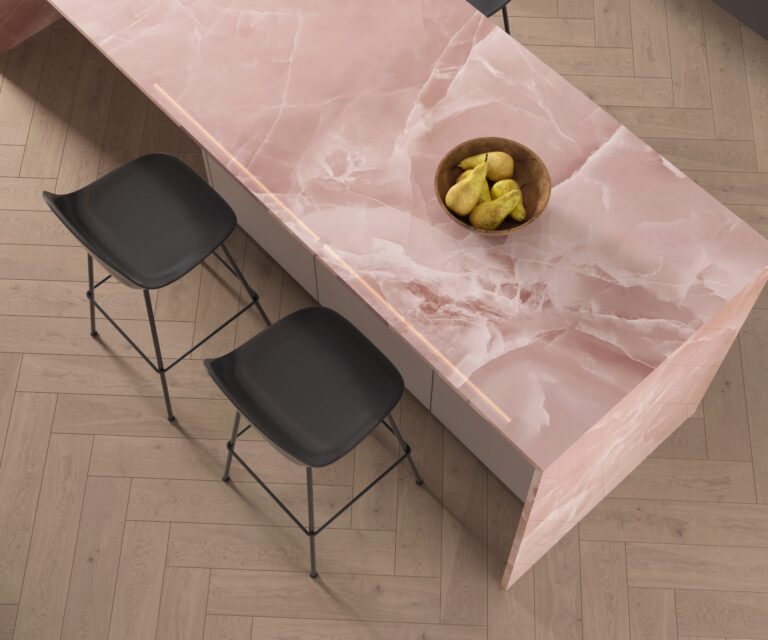

A triple bullnose edge is a stone edge with three rounded tiers stacked one above the other, so it reads as a soft, layered moulding rather than a single curve. It needs real depth, usually a built-up edge, and it suits marble vanities, bars and classical islands better than a strictly minimal kitchen.
The profile has been around for a long time on furniture, mantels and stair nosings, but it is having a moment on worktops again. This guide covers what makes it different from the simpler edges, how the depth is achieved, which stones take it well, and how to live with it.
If you are still choosing between the main families of edge (eased, bevel, single bullnose, ogee, mitred), start with our guide to countertop edge profiles. This article picks up where that one stops.
What does a triple bullnose look like?
Picture a single bullnose: the edge of the stone rounded into one smooth half-cylinder, like the nose of a stair tread. Now picture three smaller ones, one on top of the other, each separated from the next by a shallow groove. Seen from the side, the edge ripples. Seen from the front, it reads as three soft horizontal lines.
The tiers are usually equal in height, which gives a calm, regular rhythm. Some workshops grade them, with a fuller bottom roll and slimmer tiers above, so the edge looks more like a classical moulding. The names vary between fabricators, so always agree the profile on a drawing or a sample before any stone is cut.
Where does the triple bullnose come from?
Its ancestry is architectural. The bases of classical columns are built from rounded convex mouldings, known as torus mouldings, stacked with concave grooves between them. Joiners borrowed the same idea for table edges and cornices; stonemasons used it on mantels, sills and steps.
That history explains why the profile looks at home in rooms with panelled walls, cornices and turned legs. It is a small piece of classical architecture brought down to hand height.
Why are designers choosing it again?
Design and lifestyle magazines in the United Kingdom and the United States have spent 2026 writing about decorative edges, with ogee, fluted and triple bullnose profiles named most often. Living Etc included the triple bullnose in its round-up of the trend, with a designer describing the effect as chunky but softened.
That is a fair summary of its appeal. A triple bullnose gives a worktop visual weight, like a thick slab, without a hard corner. It catches light along three lines instead of one, and it invites the hand. In a room full of flat, sharp surfaces, it is the one detail that feels made rather than manufactured.
Not everyone is convinced. Some of the same publications warn that ornate edges suit traditional rooms and can date a contemporary kitchen. We agree with the warning, and we come back to it below.
How thick does stone need to be for a triple bullnose?
Thick. Three tiers need room to be three distinct rolls rather than a ripple. A single 2 cm or 3 cm slab is rarely deep enough on its own to give each tier a convincing shape.
The usual answer is a built-up, or laminated, edge. A strip of stone is bonded beneath the front of the top, doubling or tripling the visible thickness, and the profile is then cut through the whole depth. The top itself stays at its normal thickness behind the edge, so the worktop does not carry the weight of a solid block.
Two details separate a good build-up from a poor one:
- The strip should come from the same slab as the top, cut alongside it, so the veining and colour carry down the edge without a visible change.
- The joint should sit in one of the grooves. A triple bullnose has a natural advantage here: the valley between two tiers is the perfect place to hide the bond line, where a shadow falls anyway.
On a single bullnose, the joint has nowhere to hide. On a triple bullnose, done well, you should not be able to find it.
Which stones suit a triple bullnose edge?
Most natural stones can take the profile. Some show it off better than others.
- Marbles with movement are the classic choice. The tiers cut across the veining and expose it in three bands, which is why violet stones such as Calacatta Viola and Arabescato Violet look so rich with this edge.
- Quiet white and cream marbles suit it in classical rooms, where the profile itself becomes the decoration.
- Granite and quartzite take the profile well. They are harder than marble, so the edge is more resistant to knocks once made.
- Breccias, made of cemented fragments, need a careful eye: the profile runs across fragments of different colour and density, which can look wonderful or busy depending on the stone.
- Engineered surfaces depend on what lies under the top face. A profiled edge exposes the inside of the slab. If the pattern is only on the surface, the edge will show it. Ask the maker before you choose the profile.
Does the finish of the edge matter?
Yes, more than on a simple edge. On a polished stone, each of the three tiers carries its own line of reflected light, which is what gives the profile its liveliness. On a honed stone, the edge reads as soft shadow rather than shine, quieter and more contemporary.
As a rule, the edge should match the top. A polished edge on a honed worktop shows fingerprints and etch marks that the top hides, and it reads as a separate band. Our honed vs polished finish guide explains the trade-off in more detail.
Where does a triple bullnose work best?
It is at its best where people see the edge at close range and touch it often:
- Bathroom vanities, especially in classical or transitional bathrooms with framed mirrors and wall panelling.
- Bars and bar tops, where the edge sits at elbow height and the soft roll is comfortable to lean on.
- Kitchen islands in traditional kitchens, where it signals that the island is furniture, not just a worktop.
- Table tops, consoles and fireplace mantels, which is where the profile spent most of its history.
It is a harder fit for a minimal kitchen with flat-front cabinets and integrated handles. There, a pencil or eased edge does a better job of letting the stone speak.
How do you care for a triple bullnose?
The rounded tiers are forgiving. They have no knife-edge to lose, so they resist chipping better than a square edge or the fine ridges of an ogee. The grooves are the part that asks for attention: crumbs, dust and soap residue settle in them.
A soft, damp cloth run along each groove, then a dry one, is enough for daily care. Avoid acidic or abrasive cleaners on marble, and reseal the edge with the top. Our guide to cleaning and caring for marble covers what is safe to use.
How do we make a triple bullnose in our workshops?
We cut and finish triple bullnose edges in our own workshops in Surabaya, together with the tops they belong to, so the edge is shaped, polished or honed and checked before the piece leaves for installation.
That matters for a profile like this: three tiers must stay even along the full length of the edge, and around any curve or corner, to look right.
Before any cutting, the exact profile should be agreed on a drawing: the height of each tier, the depth of the grooves and the finish. Bring a drawing or a photograph of the edge you have in mind to one of our showrooms, and talk it through with the slab in front of you.
Triple bullnose at a glance
| Question | Triple bullnose |
|---|---|
| Look | Three rounded tiers, a soft layered moulding |
| Depth needed | Deep; usually a built-up (laminated) edge |
| Best stones | Marbles with movement, quiet classical marbles, granite, quartzite |
| Best rooms | Classical vanities, bars, traditional islands, tables, mantels |
| Chip resistance | Good; no sharp arris |
| Cleaning | Easy on the rolls; grooves need a cloth run along them |
| Finish | Match the top; polished shows three light lines |
| Risk of dating | Low in classical rooms, higher in minimal ones |
Frequently asked questions
What is the difference between a bullnose and a triple bullnose?
A bullnose rounds the edge into a single smooth curve. A triple bullnose stacks three smaller rounded tiers, separated by shallow grooves, so the edge reads as a layered moulding. It needs more depth than a single bullnose, so it is usually made on a built-up edge.
Can a triple bullnose be made on a 2 cm marble slab?
Usually not from the slab alone, because the tiers come out too shallow. The common solution is to bond a strip of the same marble beneath the front edge to build up the depth, then cut the profile through both layers, ideally placing the joint inside one of the grooves.
Is a triple bullnose edge hard to clean?
Not especially. The rounded tiers clean with a single pass of a cloth; only the grooves between them collect crumbs and residue. Running a damp cloth along each groove, then drying it, is enough. It is easier to keep than an ogee, whose deeper hollows trap more dirt.
Does a triple bullnose suit a modern kitchen?
It can, in a warm or transitional modern kitchen, especially on an island with a honed finish. In a strictly minimal kitchen with flat cabinet fronts, it tends to look out of place, and a pencil or eased edge is usually the better choice.
Will a triple bullnose look dated in ten years?
In a classical or transitional room, unlikely: the profile has centuries of use behind it. Where it is used only to follow a trend, in a room that does not share its language, it is more likely to date. Choose it because it suits the room.
An edge with three tiers is a small thing, a few centimetres of stone; made well, it is the part of the room that a hand remembers.