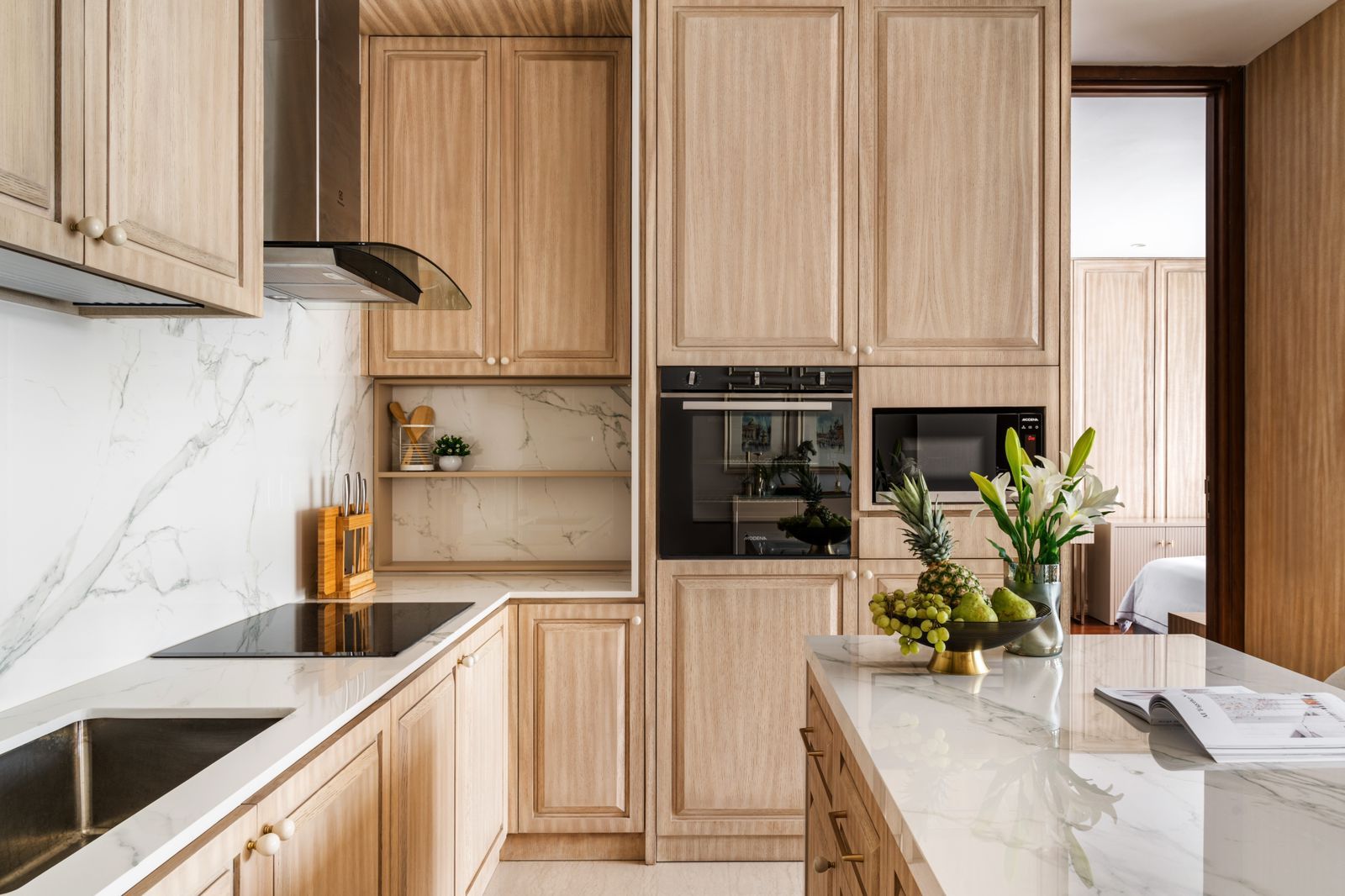
A waterfall island is a kitchen island whose stone top turns at one or both ends and drops straight to the floor, joined at a 45-degree mitre. Done well, the veining flows over the corner unbroken, which takes careful slab planning, extra material and a fabricator who treats that corner as the joint that matters most.
A flat countertop sits on a cabinet; a waterfall reads as a single sheet of stone folded over it, closer to sculpture than joinery. What the photographs do not show is how much of that effect is decided before a single cut is made.
How is a waterfall island made?
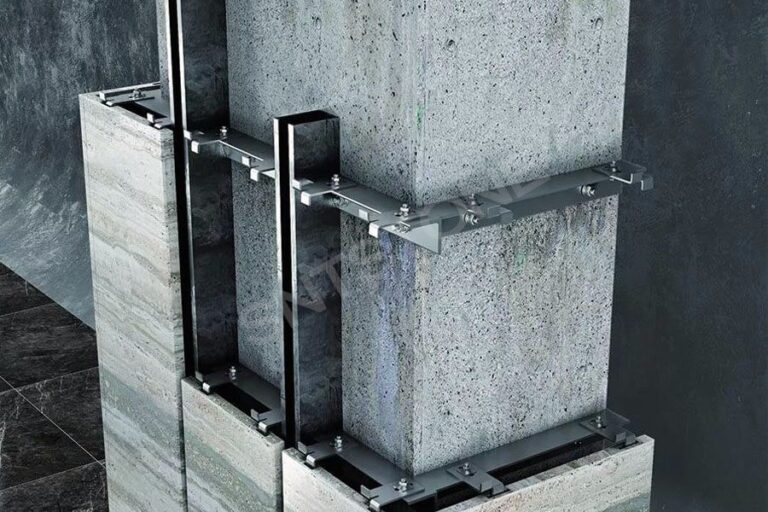
The top and each leg are cut as separate pieces, and the meeting edges are cut at 45 degrees so they close into a right angle with the joint sitting exactly on the corner. The two are bonded with an epoxy tinted to match the stone, clamped square while it cures, and usually reinforced from behind with a bracket or blocks so the joint is never asked to carry load on its own.
The front edge of the top is often mitred as well, adding a strip beneath it so a 2cm slab reads as a thick block. The legs stand on the finished floor and are fixed to the cabinet, so the stone looks as though it rises out of the ground rather than resting on a plinth.
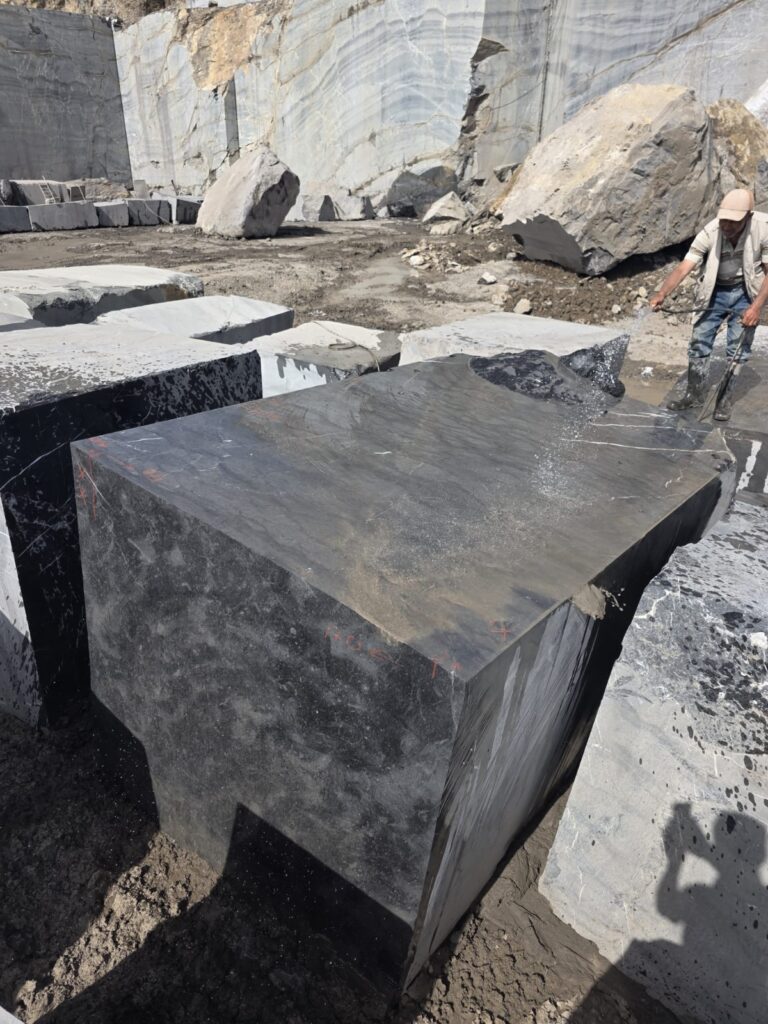
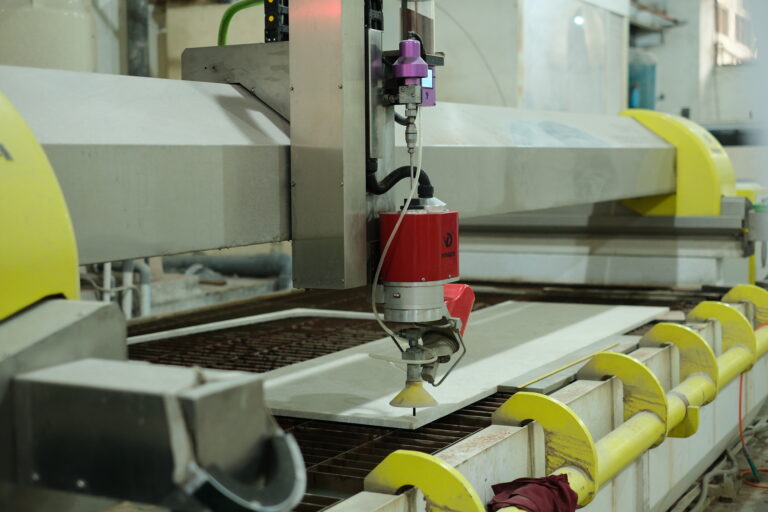
An L-shaped piece of stone is awkward to transport and lift into a finished house, so many waterfalls are cut and prepared in the workshop and closed on site. At MM Galleri, panels are vein-matched and pre-cut in Surabaya before they leave the factory, so the pattern is settled long before installation day.
How can the veining be matched across the corner?
The layout of the veining is the single biggest decision in the whole piece, and the one most often left too late.
Continuous, or sequence-matched
The leg is cut from the same slab as the top, or from the next slab in the sequence, so a vein that crosses the top appears to pour over the edge and down to the floor as though the slab had been folded. This is the look most people picture. Many slabs are not long enough to give a long top and a full-height leg from one piece, so it often needs consecutive slabs from the same block.
Bookmatched at the corner
Two consecutive slabs are opened like the pages of a book, one flipped, so the pattern mirrors itself across the joint. On a boldly veined stone this creates a deliberate symmetry at the fold, the same principle behind bookmatched marble walls, turned through ninety degrees.
Unmatched
The leg is cut from wherever is most economical and the veins do not align. On a quiet, evenly patterned stone this can be perfectly acceptable. On a dramatic one, a vein that stops dead at the corner is the first thing anyone notices.
Double waterfall
Both ends drop to the floor, and the veining now has to make sense across two folds and the full length of the top between them.
Why does a waterfall need extra stone?
Because the veining, not the tape measure, decides where the cuts go. To make a vein pour over the edge, the leg has to be cut from a particular part of a particular slab, which leaves offcuts that a flat top would never produce. A double waterfall on a boldly veined marble can easily consume a third slab, or more, from the same block.
The practical answer is to plan on the actual slabs rather than on a catalogue photograph. Lay the top and legs out over photographs or templates of the slabs you will receive, and where you can, ask the showroom whether you can see the slabs themselves. Buying slabs from one block, in sequence, is what makes the matching possible at all.
How do you protect the mitred corner?
The corner of a waterfall island is where it is most beautiful and most vulnerable. Two spots take the knocks: the top outer edge, where hips, trays and pans pass, and the bottom of the leg, where chairs, feet and cleaning machines strike.
- Ease the corner slightly. A razor-sharp arris on marble is the first thing to chip. A very small radius protects it without spoiling the folded look.
- Keep the joint tight and tinted. A well-matched epoxy line is barely visible; a pale or wide one draws the eye to exactly the wrong place.
- Mind the floor line. Some designers leave a slim shadow gap or recess at the base of the leg so that mops and chair legs meet the floor, not the stone.
If a chip does happen, it can usually be filled with colour-matched resin and polished back by a fabricator. A honed or leathered finish makes that repair far easier to disguise than a polished one.
How heavy is a stone waterfall, and can the floor take it?
Marble weighs about 2.7 tonnes per cubic metre, so a 2cm slab is roughly 54 kg per square metre and a 3cm slab roughly 81 kg. A 2cm island top of three metres by 1.1 metres with a waterfall leg at each end comes to just over five square metres of stone, roughly 285 kg before the cabinet, the mitred apron or anything placed on it.
On a ground-floor concrete slab this is rarely a concern. On a suspended timber floor, an upper floor or an older building, ask a structural engineer before committing, since the load is concentrated along the island and on the base of each leg. Timber floors can also flex slightly, and a rigid stone mitre does not forgive movement. The floor under the legs must be level, too; the stone will show every millimetre of fall.
Which stones suit the waterfall look?
A stone with strong, directional veining makes the most of the fold, because the eye follows the pattern over the corner. Statuario, Calacatta and the Arabescato family are the classic choices, and on those stones the continuous or bookmatched layout is almost always worth the extra slab.
Quartzite suits an island that will be cooked on every day. It is considerably harder than marble and does not etch in the same way, while many quartzites carry the same sweeping movement. For the working side of that choice, our guide to the best natural stones for kitchen islands goes further.
Sintered stones such as Lapitec and Dekton are lighter to live with and very hard-wearing. Lapitec is full-body, so the colour runs through the slab and a mitred edge shows the same body as the face. With any surface whose pattern sits mainly on the face, check a sample of the mitred edge before committing, because the cut can reveal a plainer core.
Waterfall island vein layouts compared
| Layout | How it is cut | Look at the corner | Material needed | Best with |
|---|---|---|---|---|
| Continuous (sequence-matched) | Leg cut from the same or next slab in sequence | Veins pour over the edge unbroken | High; often consecutive slabs | Bold, directional marble and quartzite |
| Bookmatched | Two consecutive slabs, one flipped | Pattern mirrors across the joint | High; paired slabs from one block | Strongly veined marble, onyx-look stones |
| Unmatched | Leg cut where most economical | Veins stop or shift at the corner | Lowest | Quiet, even stones; plain sintered surfaces |
| Double waterfall | Either method, at both ends | Two folds to resolve | Highest; plan three or more slabs | Large islands in open-plan rooms |
Frequently asked questions
How much extra stone does a waterfall island need?
It depends on the stone and the layout. A single waterfall on an evenly patterned stone may need little more than a flat top. A continuous or bookmatched layout on bold marble often needs an additional slab, and a double waterfall can need a third or more. Plan the layout on the actual slabs before ordering.
Can a waterfall be made in 2cm stone?
Yes, and it often is. A 2cm top with a mitred front edge reads as a thick block, and the leg is lighter to handle and install. The top needs proper support along its length, and the mitred joints need reinforcement behind them, but 2cm is common for waterfalls, especially with rare stones, which are seldom cut thicker.
Is a marble waterfall island practical for everyday cooking?
It can be, if you accept marble’s character. The top will etch where acids touch it and gather a patina over time, and the corners need a little care. A honed finish hides much of that wear. If you want the look without the upkeep, a quartzite or sintered surface is the more forgiving choice.
Can a waterfall be added to an existing island?
Sometimes. If matching slabs from the same block are still available, a leg can be added to an existing top, though the mitre must be cut into the installed edge on site, which is delicate work. More often the veining cannot be matched to a stone installed years earlier, and a new top is the cleaner answer.
A waterfall island asks more of the stone, the slab plan and the hands that join it than any flat counter does, and in return it gives a kitchen the rare sense that one piece of rock has simply been folded into place.