Bended: how MM Galleri curves marble into fluid, sculptural forms
Bended curved marble is MM Galleri’s technique for turning stone from mass into movement — a slab thinned, tested for its bending strength, and set into a curve rather than cut from a block. Developed since 2016, it produces columns, furniture, and sculptural objects roughly 40% lighter than solid stone, using about 90% of the material with no wasted mass.
What Is Bended Curved Marble, Exactly?
For most of stone’s history, curves were something you carved away — a mason removing material from a solid block until a rounded form emerged from what was left behind. Bended does the opposite. It starts with a slab thinned to a fraction of its original bulk, then flexes that slab along a curve, the way a sheet of veneer bends rather than a plank of oak.
The technique began at MM Galleri with experiments in thinning and splitting stone — simple questions about how thin a slab could go before it lost its integrity. That curiosity deepened into something closer to material science: studying the flexural and bending strength of different stones, learning which varieties tolerate a tight radius and which need a gentler arc, refining the process through repeated testing until the results could be trusted at architectural scale. Since 2016, that body of testing has become a working technique, applied to marble and other natural stone whose bending behavior has been measured and understood.
How does Bended differ from carving solid stone?
Carving is subtractive. A block goes in, material comes off, and a form is revealed — a monolithic table cut from a single block, a solid sculptural mass shaped by hand or machine. The curve you see was always inside the stone; someone just removed everything that wasn’t the curve.
Bended is closer to choreography than excavation. The stone is thinned first, its bending strength established through testing, then curved into the form the design calls for. Nothing is carved away to make room for the curve — the curve is the slab, given direction. That distinction is why Bended opens a different vocabulary: ribbon-like columns, furniture with a single continuous sweep, wall panels that turn a corner without a seam.
| Bended curved marble | Traditionally carved / solid stone | |
|---|---|---|
| Starting form | Thinned slab, bending strength tested before shaping | Solid block |
| Weight | About 40% lighter than solid stone | Full mass of the original block |
| Material efficiency | About 90% efficiency usage of material | Material removed to expose the form; waste scales with the depth of the curve |
| Design freedom | Unlimited creative freedom — tailored and bespoke per project | Bound by what a block’s mass and structural limits allow |
| Typical output | Columns, furniture, sculptural objects, curved wall panels, lit-from-within pieces | Monolithic tables, solid sculptural elements, architectural forms carved from a single block |
Why does Bended matter for design?
Solid stone has always carried a kind of authority — but that authority comes bundled with weight, and weight has limits. A column that needs to curve, a console that needs to sweep, a bathroom wall that needs to wrap a corner in one unbroken line: solid stone resists all three, or demands engineering that makes them impractical. Bended removes that ceiling. At roughly 40% lighter and 90% efficiency usage of material, it lets a designer draw a curve first and ask the stone to follow, rather than the reverse.
That freedom is tailored and bespoke by nature — no two Bended pieces answer the same brief, because no two projects ask stone to curve in quite the same way. A column is not a bathroom wall is not a lit sculptural panel. Each piece is engineered to its own geometry, tested for its own bending threshold, and fabricated to its own tolerances.
Where has Bended been used? The 7 Hartley Grove proof
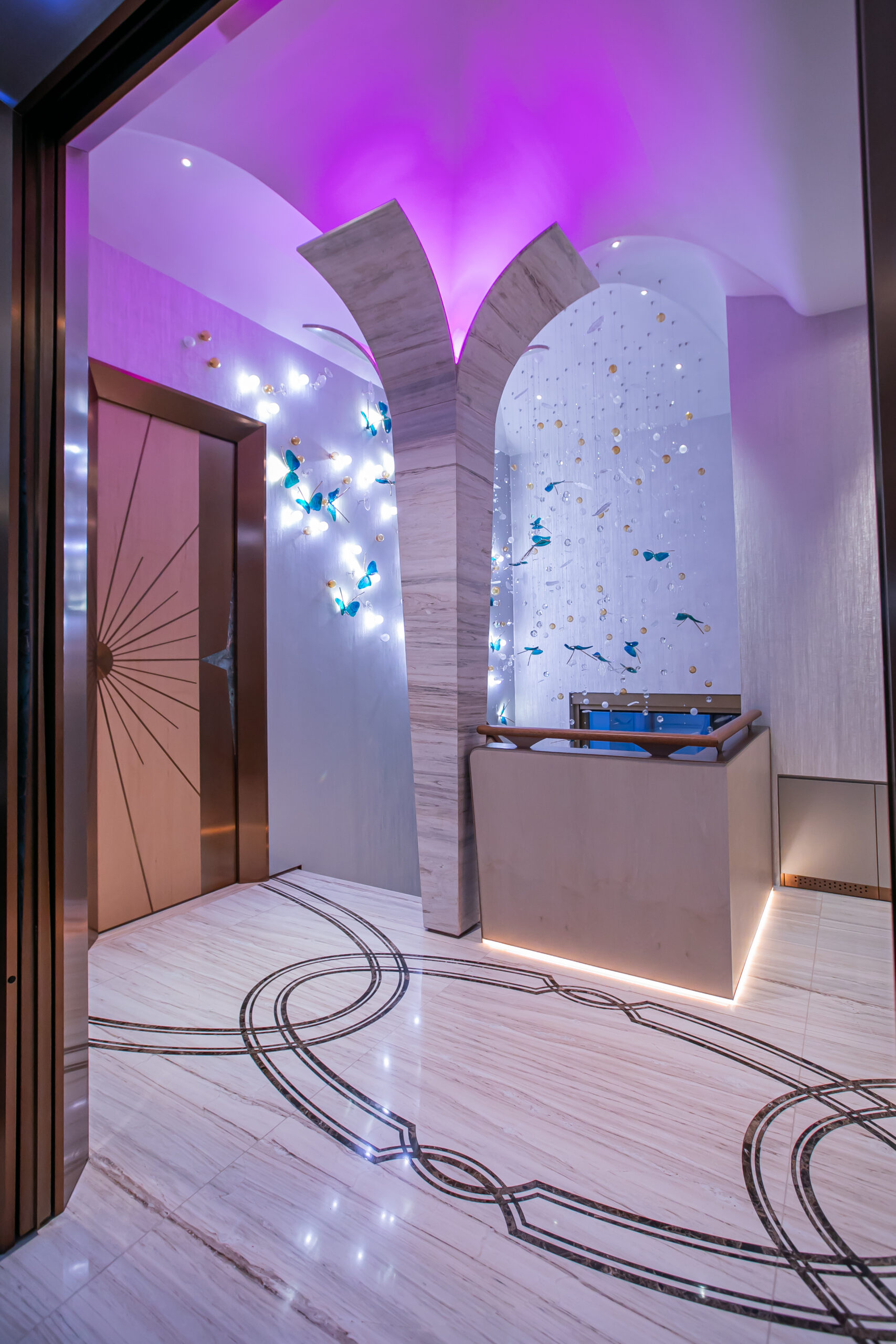
At 7 Hartley Grove in Singapore, an opulent, highly bespoke residence built on sweeping curves and decorative precision, Bended stone is not a feature — it is the architecture’s native language. Sculpted columns in Bended Palisandro rise through the interior with the ribbon-like lightness solid stone could never have allowed at that scale, their surfaces catching light along a continuous curve rather than a series of straight planes.
In the primary bathroom, Bended Golden Spider carries the same logic into a more intimate register — gold-threaded veining following the curve of the wall the way it might follow the grain of a bent sheet of wood, warm and continuous where a carved or tiled surface would have broken into seams. Elsewhere in the residence, Onyx Linea runs soft and luminous across the main floors, and an Amazonite island glows turquoise in the kitchen — proof that Bended is one instrument in a fuller material palette, deployed exactly where curvature and lightness matter most.
Bended and the turn toward monumental, sculptural stone
Architecture and interior design in 2026 have been leaning harder into monumental, sculptural gestures — columns, staircases, and freestanding forms treated less like structure and more like presence. Stone sits at the center of that shift, because nothing else carries the same weight of history while still photographing like sculpture. The complication has always been literal weight: a monumental gesture in solid stone is a monumental engineering problem.
Bended answers that complication directly. It lets a residence commission a column the scale of a statement piece without the load, the freight cost, or the structural compromise a solid equivalent would demand. As more architects reach for stone as sculpture rather than stone as surface, a technique that keeps the material honest — still stone, still veined, still cool to the touch — while cutting its weight by 40% is not a minor convenience. It is what makes the ambition buildable.
Bended shares its weight-saving logic with 8MM laminated marble, MM Galleri’s other technique for making heavy stone practical at scale. The broader pull toward monumental, sculptural stone described above shows up across the industry; World of Stones USA’s 2026 luxury stone report tracks the same trend.
Frequently asked questions
What is Bended stone?
Bended is MM Galleri’s technique, developed since 2016, for curving marble and other natural stone into fluid forms — columns, furniture, sculptural objects. Rather than carving material away, a thinned slab is flexed along a tested curve, producing pieces about 40% lighter than solid stone with roughly 90% efficiency usage of material.
How is Bended different from carving marble?
Carving removes material from a solid block until a shape emerges. Bended starts with a slab already thinned and tested for its bending strength, then curves it directly — no material removed to reveal the form. The result is lighter, uses material more efficiently, and allows curves solid stone’s mass would never permit.
Which stones can be Bended?
Bended has been applied to marble and other natural stones whose flexural and bending strength MM Galleri has studied and tested — including Palisandro and Golden Spider, both used at 7 Hartley Grove in Singapore. Suitability depends on a stone’s tested bending threshold, so each application is engineered to the specific stone and curve required.
Is Bended stone weaker than solid marble?
Bended is refined through testing specifically to establish each stone’s flexural and bending strength before it is curved, so every piece is engineered within a threshold that stone can safely hold. It is a different structural approach from solid stone, not a compromised one — thinner and lighter, built to the curve it was tested for.
Where can I see Bended stone in a finished project?
7 Hartley Grove, an opulent bespoke residence in Singapore, is MM Galleri’s clearest proof point: sculpted Bended Palisandro columns running through the interior, and Bended Golden Spider wrapping the primary bathroom in continuous, gold-threaded curves.
Can Bended stone be custom-designed for a specific space?
Yes. Bended is tailored and bespoke by nature — MM Galleri’s key stat for the technique is unlimited creative freedom, meaning each column, console, or panel is engineered to its own geometry rather than adapted from a standard form.
Together, the columns and the bathroom wall at 7 Hartley Grove make the same argument twice: that stone thinned, tested, and curved rather than carved can hold a room’s most sweeping gestures — Palisandro rising light through the interior, Golden Spider wrapping a bathroom in one unbroken, gold-threaded line — and that Bended, nine years into its own testing, has become MM Galleri’s most direct answer to what stone can still become.